
 +86 18126095160
 bella@noparde.com



2026-08-12 5
Primary keyword: gobo projector projection distance image size
Related keywords: gobo projector image size chart, gobo projection distance calculator, gobo projector lens ratio, projected logo size, gobo projector brightness
How large will a gobo projection be at a distance of 5, 10, or 15 meters? This is one of the most important questions to answer when selecting a gobo projector and planning its installation.
The projected image size depends on two main factors: the distance between the projector and the projection surface, and the ratio of the installed lens. Our gobo projectors are available with 0.33, 0.65, and 1.0 projection-ratio lenses. Each option produces a different image diameter at the same distance.
This guide explains how to calculate the projected pattern size, compare the three lenses, and choose the right combination of projection distance, image diameter, and brightness.
For our projector lenses, the approximate image diameter is calculated using the following formula:
Projected image diameter = Projection distance × Lens ratio
The projection distance and image diameter must use the same unit.
For example, with a 0.33 lens at a distance of 5 meters:
5 m × 0.33 = 1.65 m
The projected image will therefore be approximately 1.65 meters in diameter.
At a distance of 10 meters:
10 m × 0.33 = 3.30 m
At 15 meters:
15 m × 0.33 = 4.95 m
This calculation matches the distance-to-image-size relationship shown in the product specifications.
The following chart shows the estimated image diameter produced by the three available lens ratios.
|
Projection distance |
0.33 lens |
0.65 lens |
1.0 lens |
|
3 m |
0.99 m |
1.95 m |
3.00 m |
|
5 m |
1.65 m |
3.25 m |
5.00 m |
|
8 m |
2.64 m |
5.20 m |
8.00 m |
|
10 m |
3.30 m |
6.50 m |
10.00 m |
|
15 m |
4.95 m |
9.75 m |
15.00 m |
|
20 m |
6.60 m |
13.00 m |
20.00 m |
These figures are nominal estimates. The visible artwork may be slightly smaller than the full projected circle if the gobo design includes a transparent margin around the logo or pattern.
Installation angle, lens tolerances, focusing, and surface conditions may also cause minor differences in the final image.
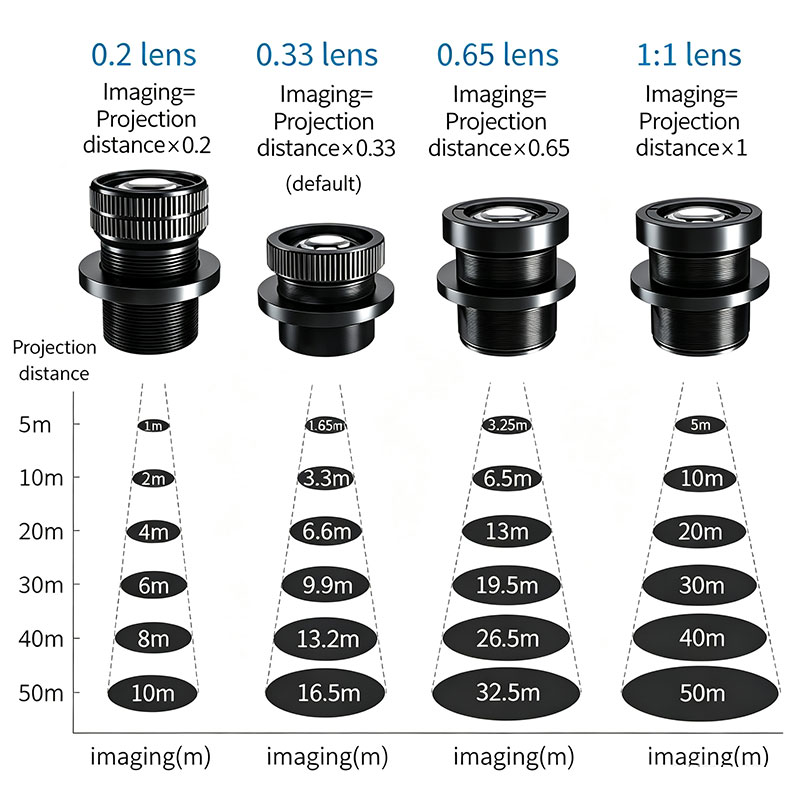
The 0.33 lens produces an image diameter equal to approximately 33% of the projection distance.
For example:
Because it creates the smallest image of the three lens options, the 0.33 lens concentrates the projector’s light over a relatively limited area. This generally makes it the preferred choice for longer projection distances, outdoor logo advertising, building façades, or installations that require a bright and concentrated image.
It is also useful when the installation location is far away from the target surface but the required logo is only a few meters wide.
The 0.65 lens produces an image diameter equal to approximately 65% of the projection distance.
At 5 meters, the image diameter is approximately 3.25 meters. At 10 meters, it becomes approximately 6.50 meters, and at 15 meters, it reaches approximately 9.75 meters.
This lens offers a practical balance between image size and light concentration. It is suitable for many commercial applications, including:
Choose the 0.65 lens when the 0.33 lens produces an image that is too small but the 1.0 lens creates an image that is larger than the available surface.
With the 1.0 lens, the image diameter is approximately equal to the projection distance.
For example:
The 1.0 lens creates the largest projected image among the three available options. It is suitable for large-area decorative projections, event stages, spacious indoor venues, floors, walls, and other applications where a large pattern is required.
However, producing a larger image means spreading the projector’s light over a greater area. A more powerful projector or a darker environment may therefore be necessary to maintain sufficient visibility.
Begin by measuring the projection distance and deciding how large the final image should be.
The required lens ratio can be estimated with this formula:
Required lens ratio = Desired image diameter ÷ Projection distance
Suppose the projector will be installed 10 meters from the wall and the desired image diameter is approximately 3.3 meters:
3.3 ÷ 10 = 0.33
The 0.33 lens is the correct choice.
If the required image is approximately 6.5 meters wide at the same distance:
6.5 ÷ 10 = 0.65
Choose the 0.65 lens.
If the desired image diameter is approximately 10 meters:
10 ÷ 10 = 1.0
The 1.0 lens is the closest option.
When the calculated ratio falls between two available lenses, it may be possible to adjust the projector’s mounting distance. Brightness and the physical dimensions of the projection surface should also be considered before making the final selection.
|
Project requirement |
Recommended lens |
Estimated image diameter |
|
5 m distance, about 1.65 m image |
0.33 |
1.65 m |
|
5 m distance, about 3.25 m image |
0.65 |
3.25 m |
|
5 m distance, about 5 m image |
1.0 |
5.00 m |
|
10 m distance, about 3.3 m image |
0.33 |
3.30 m |
|
10 m distance, about 6.5 m image |
0.65 |
6.50 m |
|
15 m distance, about 5 m image |
0.33 |
4.95 m |
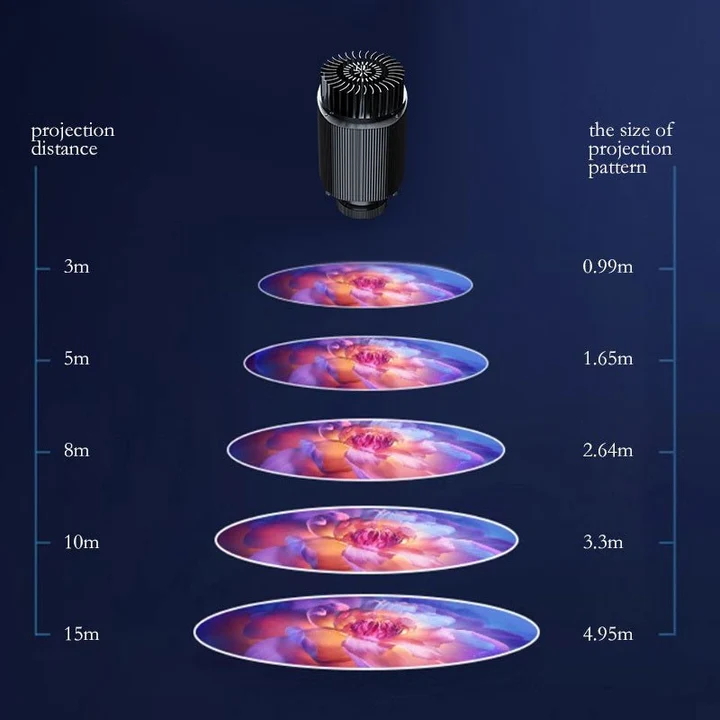
Image size and brightness must be evaluated together. When a lens produces a larger image, the available light is distributed across a larger surface area.
For the same projector and distance, the 0.33 lens generally creates the smallest and most concentrated image. The 0.65 lens produces a medium-sized image, while the 1.0 lens covers the largest area.
The actual illuminance, measured in lux, depends on several factors:
For this reason, image dimensions can be calculated from the lens ratio, but lux values should be obtained through testing with the actual projector model.
Each product page should provide a complete performance table that combines distance, lens, image size, and measured illuminance.
|
Distance |
Lens |
Image diameter |
Center illuminance |
Recommended use |
|
5 m |
0.33 |
1.65 m |
Tested lux value |
Concentrated logo |
|
5 m |
0.65 |
3.25 m |
Tested lux value |
Medium-sized pattern |
|
5 m |
1.0 |
5.00 m |
Tested lux value |
Large-area projection |
|
10 m |
0.33 |
3.30 m |
Tested lux value |
Long-distance logo |
|
10 m |
0.65 |
6.50 m |
Tested lux value |
Large commercial space |
|
15 m |
0.33 |
4.95 m |
Tested lux value |
Outdoor or façade use |
Lux measurements should identify the projector model, lens, gobo type, ambient-light conditions, and measurement position. Center lux and average lux should not be presented as the same value.
The chart assumes that the projector is aimed directly at a flat surface. If it is installed at an angle, the circular image may become oval or distorted.
Projection onto a floor from the ceiling can also create an elongated image when the projector is not positioned directly above the target area. A custom pre-distorted gobo may help compensate for this effect.
The artwork itself also influences the visible image size. A logo surrounded by a large transparent margin will occupy less than the full calculated projection diameter. When ordering a custom gobo, the artwork should use the available image area efficiently while maintaining a safe margin.
The approximate image diameter is 1.65 meters.
The approximate image diameter is 4.95 meters.
The 0.33 lens produces the smallest and most concentrated image at the same distance.
The 1.0 lens produces the largest image among the three options.
Generally, yes. A larger image distributes the projector’s light across a greater area. The required projector power also depends on ambient light, surface color, and viewing conditions.
The gobo projector projection distance and image size can be estimated using a simple formula:
Image diameter = Projection distance × Lens ratio
The 0.33 lens produces a smaller, more concentrated image; the 0.65 lens provides a balance between size and brightness; and the 1.0 lens creates the largest projection area.
At 5 meters, the three lenses produce approximate image diameters of 1.65, 3.25, and 5 meters. At 10 meters, they produce images of approximately 3.3, 6.5, and 10 meters.
For the final installation, combine these calculations with model-specific lux data, ambient-light conditions, surface dimensions, and the required viewing distance.