
 +86 18126095160
 bella@noparde.com



2026-08-07 238
Yes, an outdoor gobo projector can operate safely in rain and demanding outdoor environments—but only when it has a suitable IP rating, properly sealed connectors, and correct installation. “Waterproof” should not be treated as a general marketing claim. Buyers should verify the product’s IP65 or IP67 test report, rain-test video, connector design, operating temperature, and installation requirements before purchasing.
A waterproof outdoor gobo projector is a projection light designed to display logos, patterns, text, or decorative images outside. It can be used on building façades, sidewalks, gardens, shopping centers, theme parks, hotels, and event venues.
Unlike indoor logo projectors, an outdoor model must resist rain, dust, humidity, temperature changes, and wind-blown particles. Its housing, lens area, cable entry, seals, and connectors all need weather-resistant protection.
However, waterproof does not necessarily mean that the projector can be submerged in water. The actual protection level depends on its IP rating.
The IP rating indicates how well an electrical product is protected against solids and water. The first digit represents dust protection, while the second digit represents water resistance.
An IP65-rated projector is dust-tight and protected against water jets. It is generally suitable for permanent or temporary outdoor installation in rain, provided that it is installed correctly.
IP65 is commonly sufficient for:
An IP65 projector should not be installed underwater or in an area where flooding is likely.
An IP67-rated projector is dust-tight and offers protection against temporary water immersion under defined laboratory conditions. It provides a higher level of water protection than IP65.
Nevertheless, IP67 does not mean unlimited underwater use. The permitted depth and duration depend on the test standard and conditions stated in the manufacturer’s report.
For most outdoor projection projects, correct installation is just as important as the IP rating.
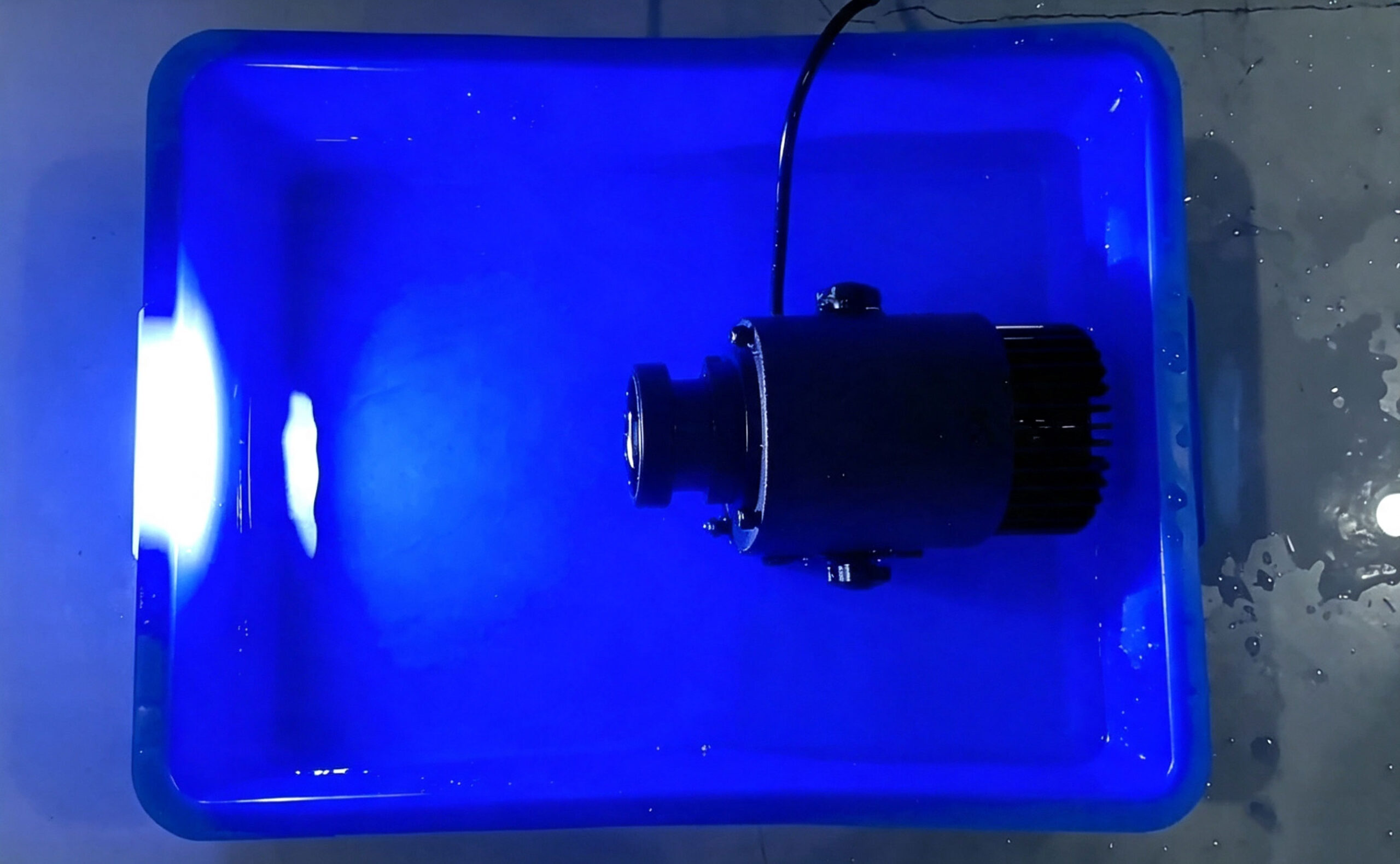
A reliable supplier should provide evidence instead of simply printing “waterproof” on the product page.
Ask for a complete test report issued by a recognized laboratory. Check that the report includes:
Confirm that the model in the report matches the projector you intend to purchase. A report for a similar housing or another product series is not sufficient proof.
A rain-test video helps buyers see how the projector performs under simulated outdoor conditions. The video should show the complete product, water exposure, cable connections, and the projector operating during or after the test.
A short demonstration video is useful, but it does not replace an official IP test report. The strongest verification combines laboratory documentation with real-product testing.
The cable connection is often the weakest point in an outdoor lighting system. Even a well-sealed projector may fail if water enters through an exposed plug or an incorrectly tightened connector.
Request close-up photographs of:
If an external power supply or controller is included, its IP rating must also be verified. An IP65 projector connected to a non-waterproof adapter is not a fully weather-resistant system.
Water resistance and temperature resistance are different specifications. A projector may pass an IP test but still be unsuitable for extreme heat or freezing conditions.
Before installation, check the manufacturer’s declared working temperature. Outdoor projectors commonly use aluminum housings, heat-dissipation structures, cooling systems, and temperature-resistant seals, but the actual operating range varies by model.
Ask the supplier to state:
Do not assume a temperature range without consulting the product datasheet. In very hot climates, avoid locations exposed to strong midday sunlight with poor ventilation. In cold climates, pay attention to condensation and repeated freeze-thaw cycles.
Even the best waterproof outdoor gobo projector requires proper installation. Follow these precautions:
For permanent installations, a qualified electrician should inspect the power connection and mounting arrangement.
Rain usually does not stop a correctly installed outdoor projector from operating, but environmental conditions can influence image visibility.
Heavy rain, fog, dust, and ambient light may reduce contrast. Projection results also depend on the projector’s brightness, projection distance, gobo design, surface color, and viewing angle.
For better outdoor performance:
Waterproof construction protects the equipment; it does not automatically guarantee a bright image in every environment.
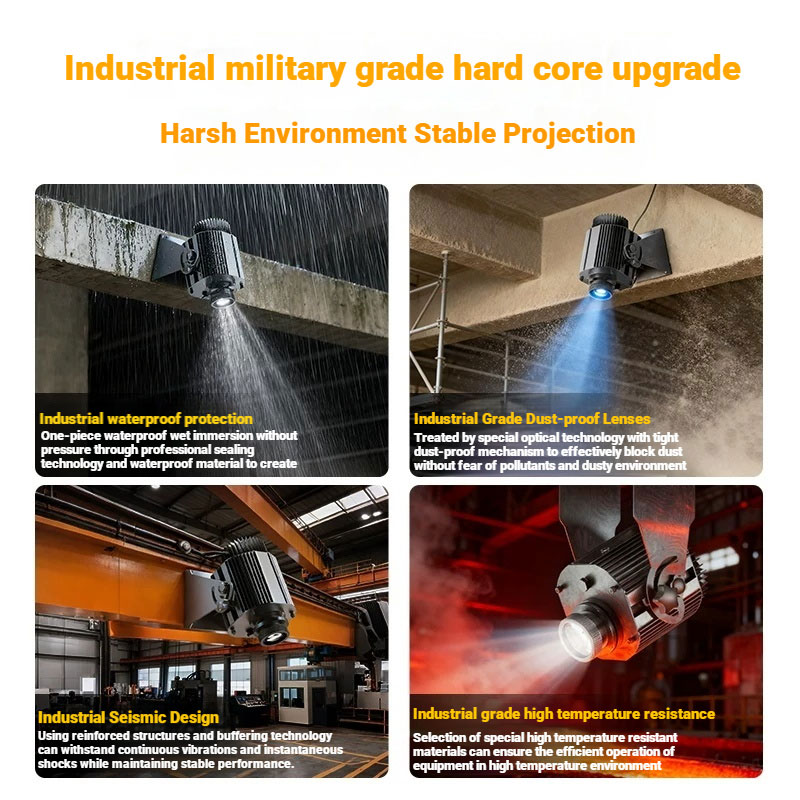
It may be suitable for long-term outdoor use if the manufacturer approves permanent installation and the projector is mounted correctly. Periodic inspection of seals, connectors, cables, brackets, and the lens is still necessary.
No. IP65 protection is designed for dust and water jets, not immersion. Use only equipment specifically certified for underwater applications.
IP67 provides protection against temporary immersion under specified test conditions. It does not guarantee unlimited submersion, high-pressure cleaning, or operation at arbitrary depths.
Yes. The entire electrical system must be protected, including the projector, connectors, power supply, controller, extension cables, and junction boxes.
Request the IP test report, technical datasheet, operating-temperature information, rain-test video, connector photos, installation manual, warranty terms, and the exact model number.
A waterproof outdoor gobo projector can be a dependable solution for outdoor logo and pattern projection, but the claim should be supported by evidence. Look for a model-specific IP65 or IP67 test report, a clear rain-test video, sealed waterproof connectors, a declared working-temperature range, and detailed outdoor installation instructions.
For most projects, the right question is not simply “Is it waterproof?” It is: What IP rating has been tested, which components are protected, and under what installation conditions can the projector operate safely?