
 +86 18126095160
 bella@noparde.com



2026-08-10 5
If you are considering a logo projector or gobo light for your business, one of the most critical questions you might ask is: "Will a gobo projection be visible in daylight?"
The short answer is it depends heavily on ambient light levels, wattage, distance, and surface contrast. While high-powered LED gobo projectors perform exceptionally well in shaded outdoor areas, indoor retail stores, and display windows, no commercial gobo projector can overpower direct, unfiltered noon sunlight.
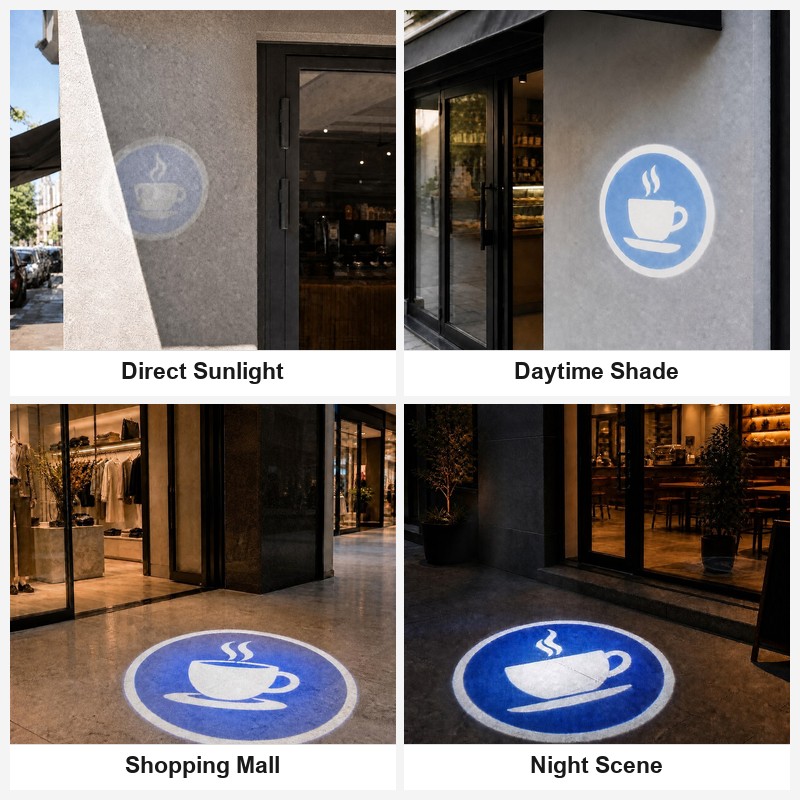
To help you choose the right projector and avoid costly missteps, we conducted real-world tests across five common lighting environments. Here is everything you need to know about daylight gobo projection.
Projected light works through contrast. For a gobo image to appear crisp, colorful, and legible, the light coming from the projector must significantly outshine the ambient light hitting the target surface.
Direct Sunlight Intensity: Ranges between 30,000 to 100,000 Lux.
Overcast Day / Shaded Outdoor Intensity: Ranges from 1,000 to 10,000 Lux.
High-Power Outdoor Gobo Output (100W–300W LED): Generates thousands of lumens, but when spread across a 2-meter image at a distance, it delivers roughly 3,000 to 8,000 Lux onto the target surface.
When 8,000 Lux of projected light hits a wall already illuminated by 50,000 Lux of direct sunlight, the projected image becomes washed out and invisible. However, when applied in shaded or indoor environments, the contrast ratio flips back in your favor.
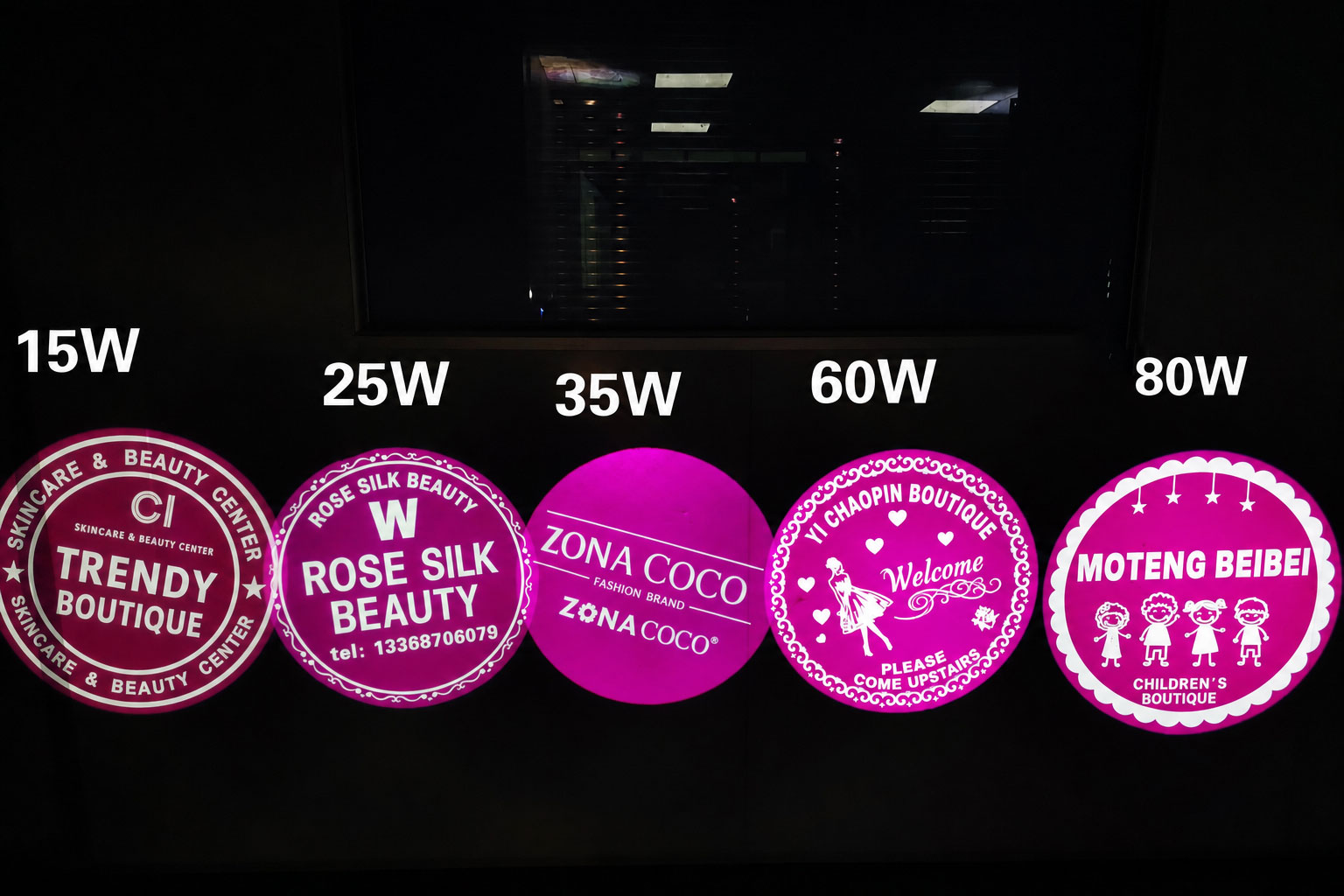
To give you an honest baseline, we tested our high-powered LED gobo projectors across five standard operational environments:
|
Environment |
Ambient Light (Lux) |
Recommended Wattage |
Projection Distance |
Visibility & Clarity Rating |
|
Direct Outdoor Sunlight |
30,000–100,000+ |
N/A (Not recommended) |
Any distance |
❌ Invisible |
|
Outdoor Shade / Covered Canopy |
1,000–5,000 |
150W – 300W |
3–6 meters |
🟡 Fair to Good (High contrast required) |
|
Indoor Shopping Mall |
30,000–100,000 |
50W – 100W |
3–8 meters |
🟢 Excellent (Sharp & vibrant) |
|
Storefront Display Window |
2,000–10,000 |
100W – 200W |
2–5 meters |
🟢 Very Good (If sun isn't hitting window) |
|
Nighttime / Dark Environments |
< 50 |
35W – 80W |
5–20+ meters |
🟢 Maximum Visibility |
Visibility: 0%
The Reality: Under direct sun exposure, the light beam from even a 300W industrial LED projector gets entirely washed out. We strictly advise against planning outdoor daytime marketing campaigns that rely on projecting onto sunlit pavement or unshaded building facades.
Visibility: 60% – 80%
The Reality: Under a covered patio, building canopy, or during heavily overcast days, ambient light drops significantly. A 150W to 300W high-lumen projector short-thrown (3 to 5 meters) onto a light-colored ground or wall will yield a clear, recognizable logo.
Visibility: 95% – 100%
The Reality: While bright to the human eye, standard indoor lighting rarely exceeds 800 Lux. A compact 50W to 100W gobo projector mounted overhead will throw a razor-sharp, eye-catching logo onto floor tile or polished concrete, effectively capturing foot traffic.
Visibility: 70% – 90%
The Reality: Projecting onto window glass or interior display walls during daytime store hours works very well, provided the window is shaded by an awning or faces away from direct south/west sun exposure.
If you need your gobo projector to perform during daylight hours or under bright indoor lights, follow these field-tested guidelines:
Wattage directly impacts light output. For indoor retail, start at 50W–80W. For daytime shaded outdoor or bright window setups, select a 150W, 200W, or 300W outdoor IP65-rated model. High-grade optical glass lenses also preserve light intensity across the projection path.
Light intensity diminishes following the inverse-square law. Halving the distance between the projector and the surface increases the image brightness by four times. Keeping the projection distance under 3 to 5 meters yields maximum punch during daytime hours.
Complex photographic artwork washes out much faster than clean vector shapes.
Best Colors: White, bright yellow, cyan, and vivid greens.
Avoid: Deep blue, dark red, or heavy gradients in bright light.
Background: Black-out glass gobo backgrounds prevent ambient light bleed and improve overall visual contrast.
White walls, light-colored pavers, and matte floor finishes reflect projected light efficiently. Dark asphalt or dark tiles absorb up to 80% of the light output, rendering daylight projection nearly impossible.
Only if the sidewalk is fully covered by an awning or deep shadow. If the sidewalk receives direct sunlight, the projection will not be visible until late afternoon or dusk.
We recommend at least a 100W to 150W LED gobo projector for glass windows operating during daytime hours to overcome ambient reflections.
Yes. Custom glass gobos allow for higher light transmission and sharper contrast than metal stamped gobos, helping maximize the overall brightness of your image.
For Nighttime & Standard Indoor Use: 35W – 80W projectors offer incredible value, crisp focus, and high clarity.
For Daytime Indoor Malls & Shaded Storefronts: Choose a 100W – 150W model with custom glass optics.
For Outdoor Daytime Applications: Ensure the installation area is shaded, keep the throw distance short, and use a high-powered 200W+ IP65 weatherproof unit.
Need expert advice on your specific setup? Contact our technical lighting team today with your installation dimensions, mounting height, and ambient light conditions, and we will recommend the precise projector wattage and gobo design for your project!