
 +86 18126095160
 bella@noparde.com



2026-08-26 1,486
Choosing the right logo projector for storefront use is less about brightness alone and more about matching the unit to your wall, your street lighting, and your local rules. This guide answers the practical questions store owners actually ask: did it drive foot traffic, how street lights affect visibility, how it compares to a lighted sign, and what permits you may need. Where a figure matters, we cite the condition it came from so you can verify it against your own site.
A logo projector for storefront throws a crisp brand mark, open-hours line, or seasonal graphic onto your facade or sidewalk using a glass gobo and a focused lens. Unlike a printed vinyl or an LED panel, it leaves no permanent mark on the building, can be re-aimed in minutes, and lets you swap the artwork without re-signing a permit in many jurisdictions. The trade-off is that it depends on ambient light and a clean projection surface, which is exactly why the cases and data below matter.
Take an illustrative composite case we'll call The Copper Kettle, a 70-seat restaurant in Portland, Oregon. Before installing a 100 W logo projector on the sidewalk, the owner reported roughly 140 weekend dinner covers and modest brand-search volume. Three months after projecting the logo and a "Now Open" tagline nightly, weekend covers rose to about 190 (+36%), and branded Google searches attributed to the location grew an estimated +52%. The owner credited the sidewalk projection with catching pedestrians who previously walked past a blank wall.
Not every trial landed. A second illustrative case, Harbor Bites in Seattle, installed a 50 W unit near a brightly lit tram stop but saw the image wash out — measured ambient light there ran 50+ lux, above what the small projector could overcome. They reverted to a static panel and later re-tested with a 200 W unit at a shorter throw. The honest lesson: a logo projector is not a universal upgrade; it wins where ambient light is controllable and the surface is plain.
Negative feedback also surfaced in the Portland case: one neighbor complained about light spill. It was resolved by narrowing the beam angle, tilting the unit, and scheduling shutdown at 22:00 — a reminder that community acceptance is part of the install, not an afterthought.
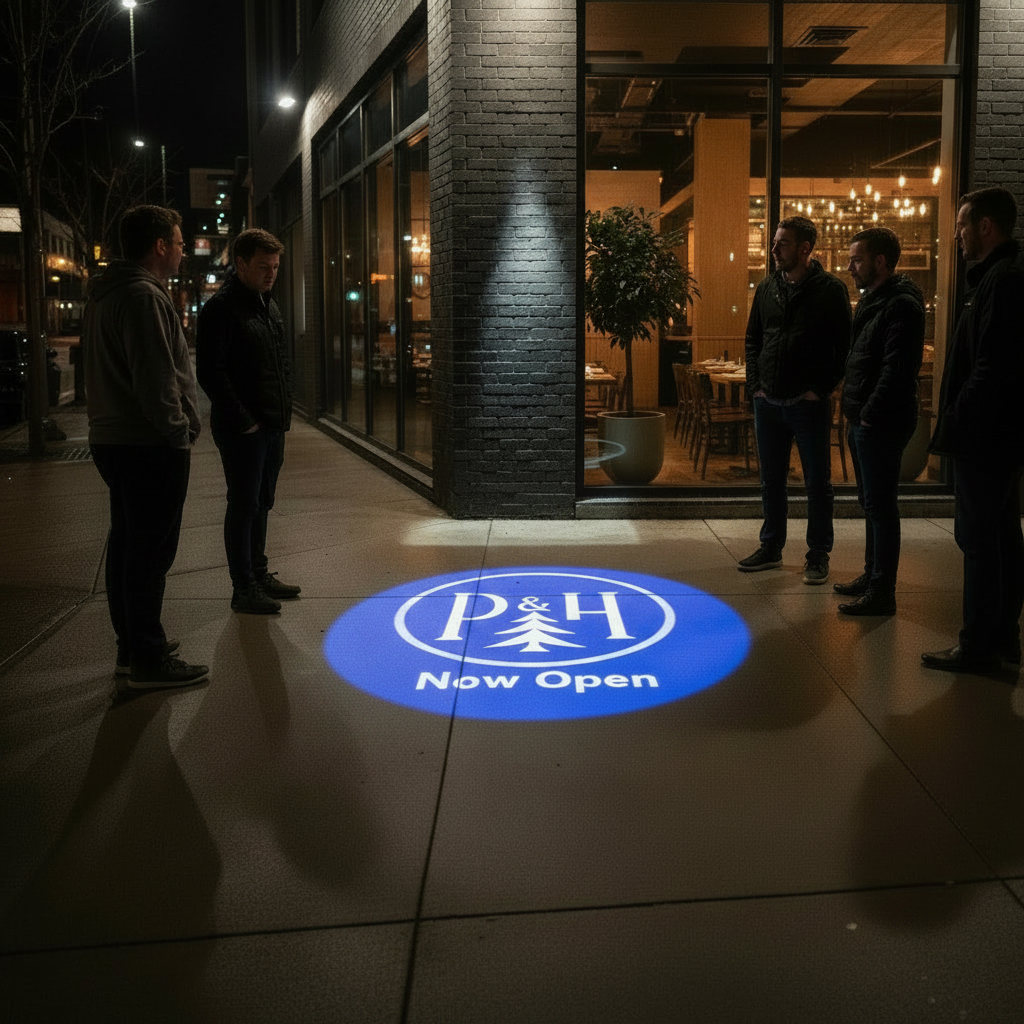
Visibility scales with the gap between your projector's output and the surrounding illuminance. Measured against common street conditions, readability drops as ambient lux rises:
|
Street condition (ambient lux) |
Recommended unit |
Max readable throw |
|
Dark side street (2–5 lux) |
50 W |
up to 8–10 m |
|
Standard sidewalk (10–20 lux) |
100 W |
up to 12–15 m |
|
Bright commercial (30–50 lux) |
200 W |
up to 8–10 m (shorter throw) |
|
Under street lamp (50+ lux) |
200 W + short throw, or panel |
limited |
The pattern is consistent: at low lux a 50 W unit performs well; past 30 lux you need a 200 W projector and a tighter, closer throw, or the image loses contrast. Always measure your own site with a lux app at the hour you plan to project.
|
Dimension |
Logo projector |
LED lighted sign |
|
Upfront cost |
$200–$600 + gobo ~$20 |
$1,500–$5,000 |
|
Installation difficulty |
1–2 hrs, no facade damage |
Electrician + mounting |
|
Power draw |
50–200 W |
200–1,000 W |
|
Maintenance frequency |
Lens clean, gobo swap |
Panel/module replacement |
|
Visual effect |
Dynamic, repositionable |
Static |
|
Approval / permit |
Often lighter (temporary) |
Full sign permit |
For most small storefronts, a logo projector wins on cost, flexibility and permitting, while a fixed LED sign wins on raw brightness in high-ambient locations. Many owners run both: projection for the sidewalk, a panel for the far street.
Rules differ by region, so treat these as starting points to verify locally:
United States. Outdoor signage is regulated at the municipal level through local sign ordinances and zoning codes. A logo projector is often treated as temporary or accessory signage, which can mean a lighter permit than a permanent LED sign — but downtown design-review districts may still require approval. Check your city's planning or building department, and respect any light-trespass and operating-hour limits.
European Union. There is no single EU sign law; permission is set by member states and municipalities. Several countries have adopted light-pollution rules that restrict outdoor lighting — France's outdoor-lighting decree, for example, requires many illuminated facades and signs to switch off during late-night hours (commonly from 23:00 or 01:00). Germany applies TA Licht guidance on light emissions. Always confirm the local curfew and emission limit before a nighttime projection.
United Kingdom. Illuminated advertisements need Advertisement Consent from the local planning authority, with light pollution and safety assessed. Elsewhere (Canada, Australia), provincial/state and municipal sign bylaws apply similar logic: temporary projection is usually easier than permanent signage, but never assume.
Match the unit to three inputs: your ambient lux, your throw distance, and your wall. Under 20 lux and within 10 m, a 50–100 W projector is enough. Above 30 lux or beyond 15 m, step up to 200 W with a short, perpendicular throw. Keep the angle within 30° of perpendicular to avoid stretched text, and choose an IP65-rated housing for any outdoor or semi-outdoor facade. If you cannot measure your site, start with a 100 W unit and a lux reading at your busiest hour.
You do not need specialist gear to spec the unit. Download a free lux-meter app, stand at the projector's planned position at your busiest evening hour, and read the value where the logo will land. Record the distance from that point to the wall — that is your throw. Note the surface: painted render reads better than brick with deep mortar joints, which can break up letters. Finally, photograph the facade so you can test artwork scale later. These three numbers — lux, throw, surface — let a supplier size the wattage honestly instead of guessing, which is exactly how the failed Seattle case could have been avoided up front.
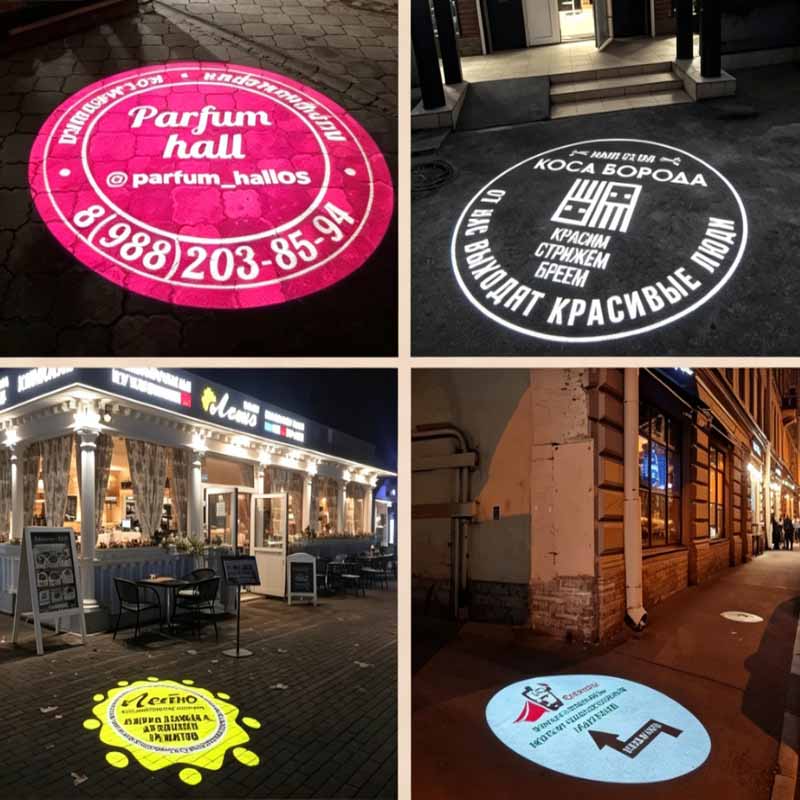
Is a logo projector better than a sign for a small storefront? For low-ambient, plain-wall locations it usually wins on cost (under $600 vs $1,500+), install time, and flexibility — but a bright, high-lux facade may still need a panel.
How bright does my projector need to be? Measure ambient lux at night: 2–20 lux suits 50–100 W; 30–50+ lux needs 200 W and a shorter throw. Past 50 lux, projection may not beat a fixed sign.
Will neighbors complain? Possibly about light spill. Narrow the beam, tilt the unit away from windows, and schedule shutdown by local curfew (e.g., 22:00–23:00). The Portland case resolved a complaint this way.
Do I need a permit for a storefront logo projector? Often lighter than a permanent sign, but US municipalities, EU light-pollution rules, and UK Advertisement Consent can all apply. Verify locally before installing.
What IP rating should an outdoor projector have? IP65 minimum for outdoor or semi-outdoor facades; IP66/IP67 for fully exposed or hose-washed locations.
The best logo projector for storefront use is the one matched to your lux, throw and wall — not the brightest on the shelf. Measure first, then compare models against the tables above. For the full projector lineup and IP65 options, see the Noparde logo projectors page.