
 +86 18126095160
 bella@noparde.com



2026-08-05 232
Primary keyword: best gobo projector for outdoor advertising
SEO title: Best Gobo Projector for Outdoor Advertising: 2026 Buyer’s Guide
Meta description: Discover the best gobo projector for outdoor advertising. Compare power, brightness, projection distance, waterproof ratings, lenses, applications, and recommended Noparde models.
Suggested URL: /best-gobo-projector-for-outdoor-advertising/
The best gobo projector for outdoor advertising is a weatherproof LED model that matches the projection distance, ambient light, image size, and installation environment of your site. For most storefronts and commercial buildings, a 100W–200W IP65 outdoor gobo projector offers the best balance of brightness, durability, image clarity, and operating cost.
However, there is no single projector that is ideal for every location. A small shop projecting its logo across a five-meter sidewalk needs a different solution from a hotel displaying a large image on a building 40 meters away.
This guide explains how to choose the right outdoor advertising projector and recommends suitable Noparde models for storefronts, events, commercial buildings, and long-distance campaigns.
For typical outdoor advertising, the Noparde JWB160-200W LED Gobo Projector is the strongest all-around option. Its high-power LED, IP65 weather resistance, improved heat management, and suitability for extended operation make it a practical choice for shops, malls, hotels, tourist attractions, and events.
For shorter projection distances and darker locations, the Noparde 100W Commercial Gobo Projector is a more economical choice. It is designed for approximately 2–15 meters of projection, although a longer throw may be possible in a sufficiently dark environment.
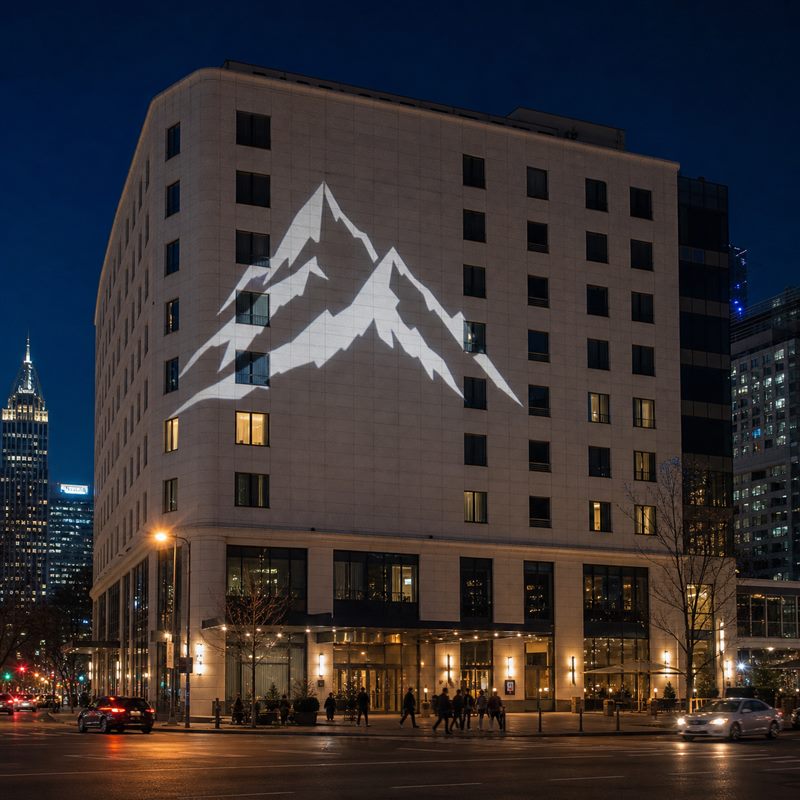
For large building façades, bright urban locations, or long-throw advertising, consider a Noparde 200W, 300W, or 400W long-distance projector, selected after an on-site projection assessment.
|
Advertising scenario |
Recommended power |
Suggested Noparde solution |
|
Small storefront or sidewalk |
60W–100W |
Noparde 100W Commercial Gobo Projector |
|
Restaurant, retail store, or mall entrance |
100W–160W |
Noparde outdoor commercial series |
|
Hotel, event venue, or medium building |
160W–200W |
Noparde JWB160-200W |
|
Large façade or high ambient light |
200W–300W |
Noparde IP65/IP67 long-distance series |
|
Landmark or very long throw |
300W–500W |
Noparde high-power custom solution |
These ranges are starting points rather than universal guarantees. The required power also depends on the lens, logo size, wall color, competing light, mounting angle, and projection distance.
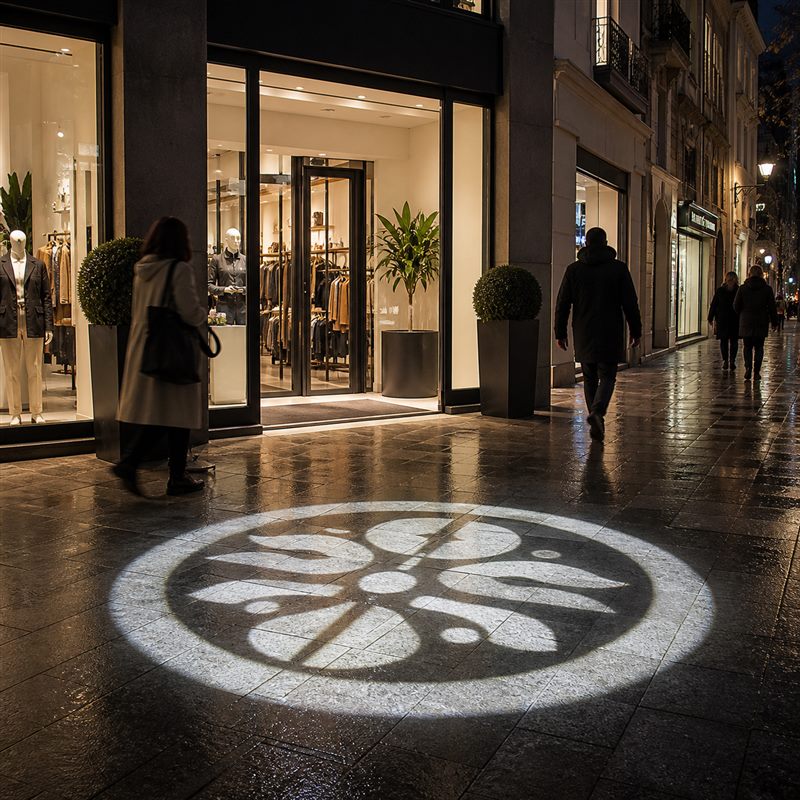
A gobo projector uses a small metal or glass image plate—called a gobo—to project a logo, message, symbol, or pattern onto a wall, pavement, or other surface.
Unlike a printed sign, the projected image does not physically cover or permanently alter the building. A business can replace the gobo when its campaign changes while continuing to use the same projector.
Outdoor gobo advertising can provide several benefits:
Gobo projectors are particularly effective for nighttime branding, seasonal promotions, product launches, wayfinding, and event advertising. They are not generally intended to compete with direct sunlight, so outdoor campaigns should normally operate after sunset or in shaded, controlled-light environments.
Wattage is useful when comparing products within a similar projector range, but it does not tell the complete story. Optical efficiency, LED quality, lens design, gobo quality, and projected image size all influence the visible result.
A 60W or 100W unit may work well on a relatively dark storefront. A brightly illuminated commercial street may require 160W–300W, even at a similar distance.
Do not choose power based only on distance. Document nearby streetlights, illuminated signs, windows, and vehicle headlights before requesting a recommendation.
As the projected image becomes larger, its light is distributed over a greater area and the image appears less bright. Consequently, a projector that produces a crisp two-meter logo at 10 meters may not produce an equally bright six-meter logo from the same position.
Measure:
The Noparde 100W commercial model lists a projection distance of approximately 2–15 meters, with the possibility of a longer distance in a dark environment. Long-distance models are available for building and wall projection, but the lens should be selected for the required throw ratio.

A light-colored, matte wall normally provides better contrast than dark brick, glass, polished metal, or heavily textured stone. Fine logo details can disappear on an uneven surface even when the projector is powerful enough.
For the best result, choose a clean, flat projection area and simplify extremely thin text or intricate artwork. A real-site projection test or photo-based simulation is especially valuable for expensive installations.
A permanent outdoor projector should have a clearly stated ingress-protection rating. IP65 means the enclosure is dust-tight and protected against water jets. It is suitable for normal outdoor rain exposure when the unit is correctly installed.
More exposed sites may benefit from an IP66 or IP67 solution. Waterproof cable connections, drainage, mounting hardware, and power supplies are just as important as the projector enclosure. Never assume that an indoor model becomes weatherproof simply because it is installed beneath a small canopy.
Noparde states that its outdoor products use weather-resistant construction and anti-corrosion treatments. Nevertheless, buyers should confirm the exact IP rating and operating temperature of the selected model rather than relying on a general product-family description.
The lens determines projection angle, image size, focus, and usable distance. A narrow-angle lens is normally better for long throws, while a wider lens creates a larger image at a shorter distance.
For professional logos, a high-resolution glass gobo is generally the better choice. It can reproduce fine details, grayscale elements, and multiple colors more accurately than a basic metal stencil. Metal gobos remain useful for simple, single-color shapes and bold text.
Ask the supplier to review the artwork before production. A logo designed for a website may contain details that are too small for a distant architectural projection.
Outdoor advertising projectors may operate for eight or more hours every night. Effective heat dissipation helps maintain brightness and extend LED and electronic-component life.
The Noparde JWB160-200 series is promoted with upgraded heat management for long-duration commercial operation. It also uses an IP65 enclosure for outdoor installations.
Install the projector on a stable, load-rated bracket and add a secondary safety attachment where required. Keep ventilation areas clear, inspect seals and cables periodically, and clean the front lens when dust or pollution begins to reduce brightness.
This model is suitable for shop logos, café entrances, sidewalk messaging, and smaller exterior walls. Published specifications include a 100W LED source, aluminum-alloy housing, AC 110–240V input, and a suggested 2–15-meter projection range.
Choose it when the site has relatively low ambient light and does not require an exceptionally large image.
The JWB160-200W is the most versatile recommendation for demanding commercial advertising. It combines higher output with IP65 protection and enhanced heat dissipation.
It is well suited to:
This model is particularly valuable when the projector must operate for long evening periods or withstand changing outdoor conditions.
For large walls, rough surfaces, longer distances, or locations with substantial ambient light, a 200W–300W outdoor unit is usually more appropriate. Noparde offers IP65 and IP67 long-distance configurations, including rotating and static logo projection options.
A 300W model should not be selected automatically just because it sounds brighter. Correct lens selection and accurate site measurements are essential to prevent an image that is too large, too small, or poorly focused.
Very large buildings, mountainside displays, and landmark campaigns require project-specific engineering. Noparde’s long-distance range includes 400W and 500W options for large-scale static or dynamic advertising.
These installations should include an illumination review, structural mounting plan, electrical assessment, weather-risk analysis, and local advertising or light-pollution approval.
In one Noparde-published storefront case, a commercial client first tested a single outdoor HD LED projector. After evaluating the image quality and ease of focusing, the client reportedly ordered eight more units for a multi-location rollout. The project demonstrates why a one-site pilot is a sensible step before a chain-wide installation. Read the Noparde storefront case study.
Another Noparde case describes a cultural tourism installation using ten 120W IP65 projectors with custom glass gobos. Different logos and traditional patterns were projected to strengthen the nighttime visitor experience. See Noparde’s outdoor projection guide and cases.
Noparde also reports using the JWB160-200W for coastal storefront and heritage-site applications where rain resistance, corrosion control, cooling, and extended operating time were important. Performance and business-impact figures in supplier case studies should be treated as reported results rather than guaranteed outcomes for every site. Review the JWB160-200W product story.
Usually not effectively in direct sunlight. Outdoor gobo advertising performs best at night, after dusk, or in a shaded area with controlled ambient light.
A 100W projector can be sufficient for a small or medium image at a short distance in a dark location. Brighter streets, larger images, and longer distances normally require more power.
IP65 is a practical minimum for many permanent outdoor installations. More exposed or severe environments may require IP66 or IP67 equipment and appropriately rated cables and connectors.
Choose a glass gobo for detailed, multicolor, grayscale, or high-definition logos. Choose a metal gobo for simple, bold, single-color designs.
Send the supplier the projection distance, desired image size, installation photos, wall material and color, ambient-light conditions, operating hours, artwork, and local weather conditions.
The best gobo projector for outdoor advertising is the one engineered for the actual site—not simply the model with the highest wattage.
For short-range storefront promotion, the Noparde 100W commercial model is a practical entry point. For most professional outdoor advertising projects, the Noparde JWB160-200W offers the best overall combination of output, weather resistance, and long-running performance. For large façades and long projection distances, a Noparde 200W–500W system with a project-specific lens is the safer choice.
Before ordering, request a site-based recommendation and, whenever possible, test one projector at the real location. That single step can prevent incorrect power, lens, image-size, and mounting decisions—and produce a sharper, more effective outdoor campaign.