
 +86 18126095160
 bella@noparde.com



2026-07-27 187
A Technical Guide to Selecting the Right Industrial Projector for Your Facility
Industrial safety signage has evolved far beyond painted lines and adhesive floor tapes. Today, facility managers and safety officers are turning to LED safety sign projectors—sometimes called virtual sign projectors or gobo projectors—to project highly visible warnings, pedestrian markings, and hazard alerts directly onto factory floors and warehouse surfaces.
Unlike physical signs that fade, peel, or become obscured by forklift traffic, projected safety signs remain crisp and visible without the maintenance costs of traditional floor marking. However, selecting the right safety sign projector requires careful consideration of three interdependent variables: mounting height, ambient lux, and desired image size.
This guide draws on Noparde’s extensive industrial projection expertise to help you navigate the technical selection process, ensuring your safety signage delivers optimal visibility in any environment.
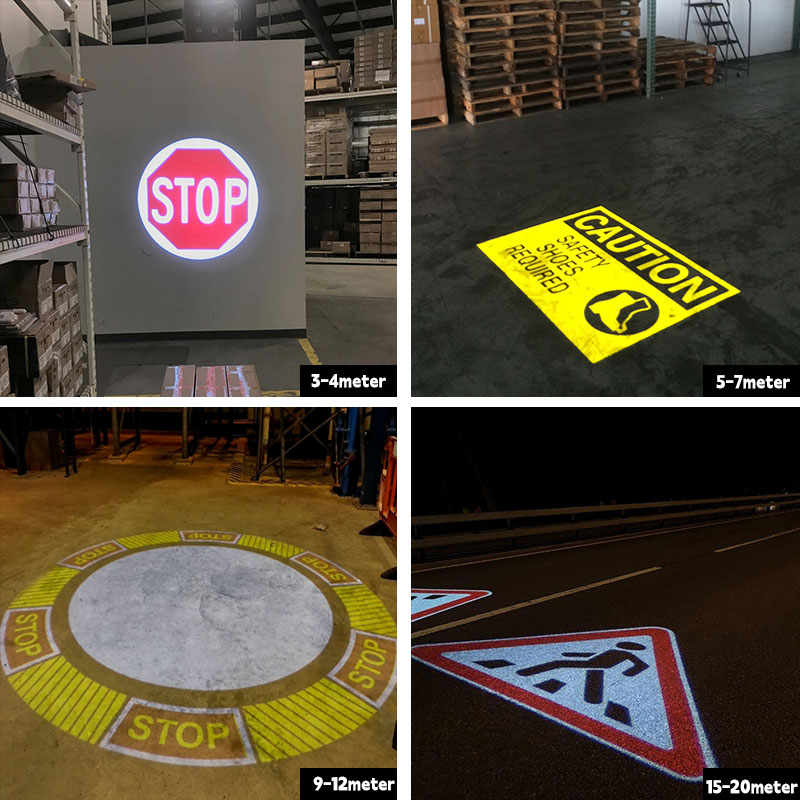
According to industry experts, the key variables in any projection application are "the ambient light level measured at the surface where the image will be projected" and "how far the image is being projected, i.e., the measurement between the projector and the surface". When either factor increases, a higher-power light source and appropriate lens combination become necessary to maintain image clarity.
The distance from the projector to the projection surface directly determines image size and brightness. Greater mounting heights require higher power output and wider beam angles to achieve usable image dimensions.
Typical industrial installations range from 3 to 15 meters, with some specialized applications reaching up to 30 meters. For standard warehouse and factory environments, most safety sign projectors are installed at heights between 4 and 10 meters.
Ambient lux refers to the existing light level at the projection surface. This is arguably the most critical factor in projector selection, as higher ambient light levels require significantly more projector output to maintain image visibility.
A safety sign projector performing well in a dimly lit warehouse may become nearly invisible in a brightly lit production area. If the ambient light level and/or projection distance is higher, it is necessary to use a higher-power light source and optic to compensate.
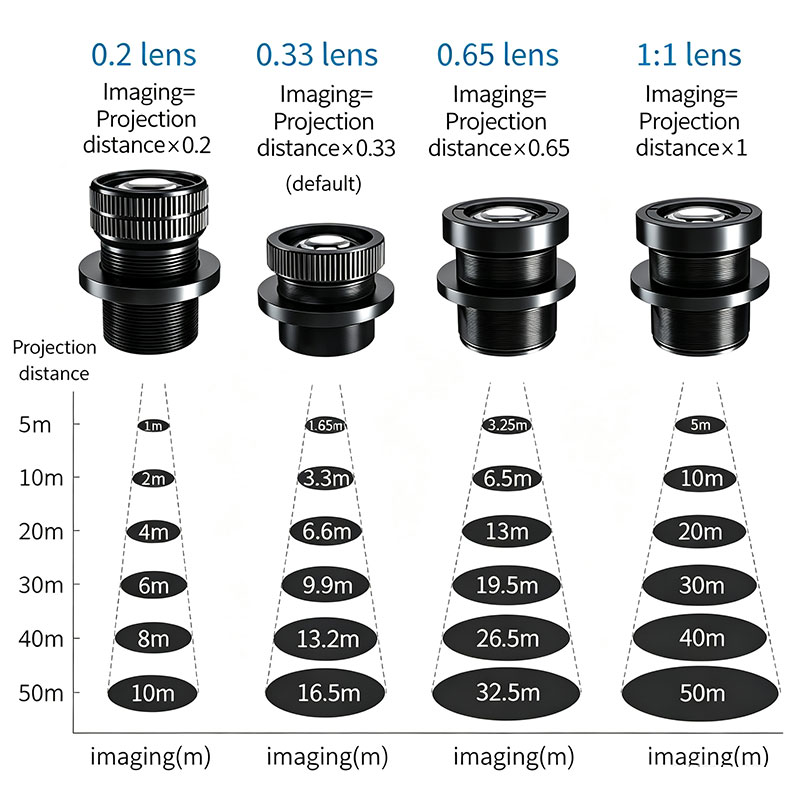
Image size is determined by the combination of mounting height and the lens installed on the projector. Noparde safety sign projectors support multiple interchangeable lens options. Based on factory specifications, the image size (imaging diameter) is calculated by multiplying the projection distance by the lens coefficient:
|
Lens Type |
Lens Coefficient |
Image Size Formula |
|
0.2 lens |
×0.2 |
Distance × 0.2 |
|
0.33 lens |
×0.33 |
Distance × 0.33 |
|
0.65 lens |
×0.65 |
Distance × 0.65 |
|
1:1 lens |
×1.0 |
Distance × 1.0 |
|
Projection Distance |
0.2 Lens |
0.33 Lens |
0.65 Lens |
1:1 Lens |
|
5m |
1.0m |
1.65m |
3.25m |
5.0m |
|
10m |
2.0m |
3.3m |
6.5m |
10.0m |
|
20m |
4.0m |
6.6m |
13.0m |
20.0m |
|
30m |
6.0m |
9.9m |
19.5m |
30.0m |
|
40m |
8.0m |
13.2m |
26.0m |
40.0m |
|
50m |
10.0m |
16.5m |
32.5m |
50.0m |
Selection rule of thumb:
A 0.2 lens produces the smallest, brightest image at a given distance—ideal for high-accuracy symbols at long range.
A 1:1 lens produces the largest image size, making it suitable for wide-area warnings at shorter to medium mounting heights.
0.33 and 0.65 lenses offer balanced solutions for most industrial applications.
Noparde offers a comprehensive range of safety projectors, from compact 7W units for small-space applications to high-output 1500W systems for large industrial environments. Here’s a practical guide to selecting the right power level:
|
Installation Environment |
Typical Ambient Lux |
Recommended Power |
Maximum Mounting Height |
Maximum Image Size |
|
Dark/Unlit Warehouse |
< 50 lux |
35-100W |
5-10m |
Up to 5m |
|
Dimly Lit Factory |
50-200 lux |
100-200W |
10-15m |
5-10m |
|
Bright Production Area |
200-500 lux |
200-300W |
12-15m |
8-14m |
|
High-Bay/Outdoor |
> 500 lux |
300-1500W |
15-30m |
10-18m |
Source: Compiled from Noparde technical specifications and industry guidelines
? Expert Tip: For areas with fluctuating light conditions, selecting a safety sign projector with higher output than the minimum requirement provides a safety margin and ensures consistent visibility throughout the day.
Unlike consumer projectors, industrial safety sign projectors use fixed or interchangeable lenses with specific coefficients. The image diameter on the floor or wall is determined solely by:
Image Size (m) = Projection Distance (m) × Lens Coefficient
For example:
With a 0.65 lens at a 10m mounting height, the projected image diameter = 10 × 0.65 = 6.5m.
With a 1:1 lens at a 5m height, the image diameter = 5 × 1.0 = 5.0m.
This linear relationship makes it easy to pre-calculate image dimensions during the planning stage. For a desired image size, simply divide the target diameter by the lens coefficient to determine the required mounting height.
⚠️ Important: Larger image sizes result in lower brightness per unit area. If your ambient lux is high, choose a smaller coefficient lens (e.g., 0.2 or 0.33) to concentrate the light output, or increase the projector’s power rating.
The color of the projection surface significantly affects image visibility. Lighter surfaces reflect more light and produce brighter images, while darker surfaces absorb light and require more power.
For Noparde safety sign projectors, which feature Cree LED lamp beads and produce high lumen outputs, the following guidance applies:
Light-colored concrete/flooring: Optimal, minimal power adjustment needed
Medium-gray surfaces: Slight power increase recommended
Dark floors or asphalt: May require one power level higher than standard recommendation
Many facilities already use dedicated forklift safety lights—such as blue spotlights or red zone indicators—to warn pedestrians of approaching forklifts. While these devices are effective for their specific purpose, they are typically fixed-beam units with limited pattern flexibility and no adjustable imaging capability.
A modern safety sign projector goes beyond the simple spot or line projection of traditional forklift safety lights. With interchangeable lenses (0.2, 0.33, 0.65, and 1:1) and customizable gobo patterns, a safety sign projector can display detailed warning symbols, directional arrows, speed limit numbers, or pedestrian crossing markings—all from the same overhead mount. In many installations, a single Noparde safety sign projector can replace multiple fixed-position forklift safety lights, reducing equipment costs and simplifying maintenance.
That said, forklift safety lights remain a cost-effective solution for basic proximity alerts, especially on mobile equipment. However, for fixed-location hazard zones—such as warehouse intersections, loading docks, and production line perimeters—a dedicated safety sign projector offers superior versatility, sharper image quality, and better adaptability to changing safety requirements.
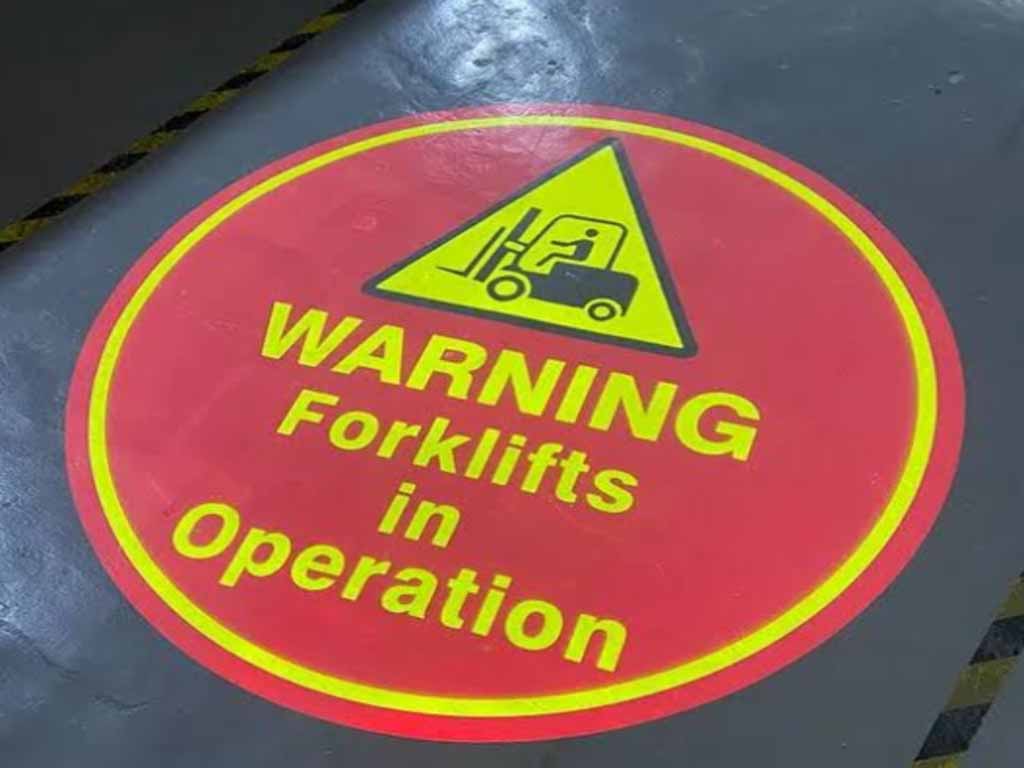
Mounting height: 5 meters
Ambient lux: ~50 lux
Desired image size: 3.25-meter warning symbol
Lens choice: 0.65 lens (5m × 0.65 = 3.25m)
Recommended projector: 100W Noparde safety sign projector with 0.65 lens
Verification: Factory 5m/10m/15m test charts confirm sufficient brightness and edge clarity
Mounting height: 10 meters
Ambient lux: ~200 lux (factory lighting)
Desired image size: 6.5-meter hazard symbol
Lens choice: 0.65 lens (10m × 0.65 = 6.5m)
Recommended projector: 200W Noparde safety sign projector with 0.65 lens
Verification: 10m test data validates projection clarity under ambient light
Mounting height: 8 meters
Ambient lux: ~400 lux
Desired image size: 8-meter pedestrian warning (approximate)
Lens choice: 1:1 lens (8m × 1.0 = 8.0m)
Recommended projector: 300W Noparde safety sign projector with 1:1 lens
Verification: 10m/15m real-world measurements confirm visibility under bright lighting
Mounting height: 20 meters
Ambient lux: ~100 lux
Desired image size: 4.0-meter aisle guidance symbol
Lens choice: 0.2 lens (20m × 0.2 = 4.0m) – narrow beam for high brightness at long distance
Recommended projector: 200W Noparde safety sign projector with 0.2 lens
Verification: 20m/30m test data verifies sharp focus and legibility
Mounting Angle: Position the safety sign projector to minimize distortion. For floor projection, a perpendicular mounting angle provides the clearest image.
Lens Selection Before Installation: Determine your required image size and mounting height first, then select the lens coefficient using the formula:
Lens Coefficient = Desired Image Size ÷ Mounting Height
Choose the closest standard option (0.2, 0.33, 0.65, or 1:1).
Environmental Protection: Noparde safety sign projectors feature IP65 to IP67 waterproofing and can withstand temperatures from -40°C to 60°C, making them suitable for demanding industrial environments.
Maintenance: With LED lifespans of up to 50,000 hours and durable aluminum alloy housings, Noparde safety sign projectors require minimal maintenance while delivering consistent safety marking.
Choosing the correct safety sign projector isn’t just about power—it’s about understanding the precise interplay between mounting height, ambient lux, image size, and lens coefficient. And while traditional forklift safety lights serve an important role in mobile equipment warning, fixed-location safety projection demands the pattern flexibility, image clarity, and lens adjustability that only a dedicated safety sign projector can provide.
For facilities with mounting heights up to 12 meters and varying light conditions, Noparde offers a range of safety sign projectors from 100W to 300W with multiple lens options (0.2, 0.33, 0.65, and 1:1) to accommodate most applications. For more demanding environments, higher-output units are available.
Ready to select the right safety sign projector for your facility?
? Submit your mounting height, ambient lux level, and desired image size to receive a personalized Noparde model recommendation, complete with application-specific test data (5m/10m/15m/20m/30m real-world measurements and lux meter verification).