
 +86 18126095160
 bella@noparde.com



2026-08-21 108
Warehouse routes are easy to understand on a floor plan. The main aisle is straight, racks sit in rows and loading areas have clear boundaries. Daily work makes the picture less tidy. Pallets wait outside their planned position, equipment pauses near a doorway and a forklift driver looks past a load that blocks part of the floor. A Green laser line projector can return a visible boundary to that changing scene, but the line has to answer a specific operational question.
A route line from a Green laser line projector may separate forklifts from pedestrians, while a short line at a doorway may warn about clearance. A grid around pallets has another purpose: it shows where storage ends and movement space begins. Treating all three as the same layout leads to lines that are bright but unhelpful. The route, the viewer and the expected decision should be defined before the beam geometry is selected.
Green is often chosen because it is highly visible to the human eye under many indoor conditions, but color alone does not solve contrast. Bright daylight near loading doors, reflective floors and dark rubber marks can all change how the line appears. A Warehouse Safety Laser plan should be checked in the brightest normal operating condition and on the actual floor material.
Long distance adds its own limits. A request for 70 metres may describe the maximum path the customer wants a Green laser line projector to cover, not the length of one equally bright continuous line. Beam spread, line width, mounting angle and interruptions along the route all matter. Several well-placed projected segments may communicate the boundary more clearly than one line expected to cross every obstacle.
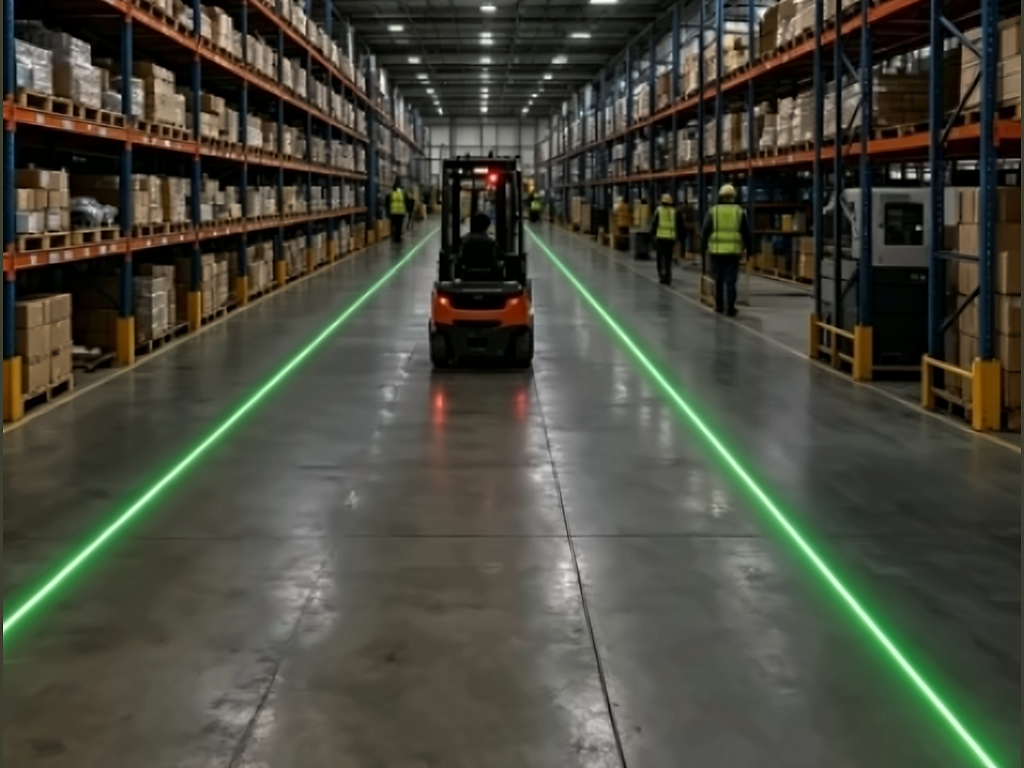
Mounting height changes the risk around the equipment. A low position between 50 and 200 centimetres can support side projection in some layouts, yet it also sits close to vehicle bodies, loads and impacts. Protective placement is essential. The line should enter the work area, while the housing remains outside the space that forklifts and pallets routinely occupy.
The green laser line projector for forklift area is most useful when the traffic rule already exists. Projection can make a lane edge easier to see during a shift, but it does not decide right of way or prevent a pedestrian from entering. Barriers, signs, training and supervision still carry those responsibilities. The projected line gives those controls a visible position on the floor.
A Russian inquiry dated April 23, 2026, brought several applications into one request. The customer wanted green laser projection inside a warehouse, a reach of 70 metres and installation between 50 and 200 centimetres. The material listed forklift route boundaries, rack outlines, loading-zone frames and exclusion areas beneath elevated work. Noparde treated the Green laser line projector as a selection task because no final model, quantity or completed installation was recorded. Site dimensions, lighting, floor color and equipment protection still had to be confirmed.
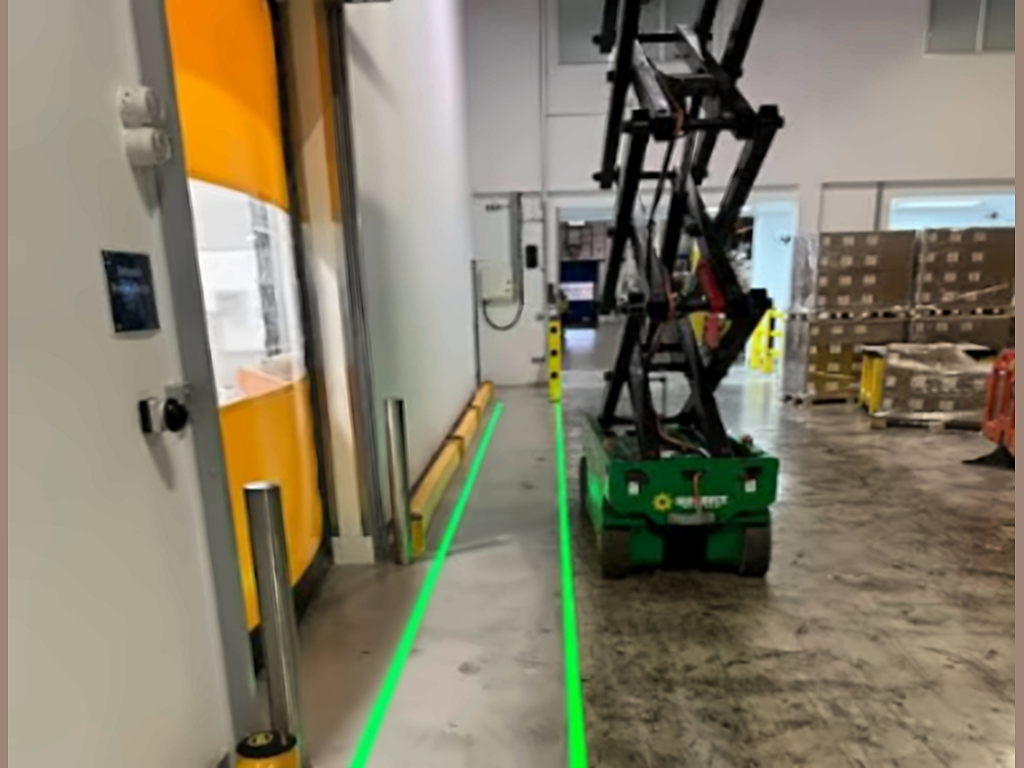
Rack protection needs a different Green laser line projector layout from a pedestrian lane. The useful reference may be the face of the upright, the outer edge of stored goods or the turning envelope of a truck. Noparde needs to know which object the driver is trying not to strike. Once that is clear, the projected boundary can be placed where it helps with the turn rather than where it merely looks symmetrical.
Loading zones also change through the day. A line that is visible on an empty floor may disappear under a pallet during the busiest hour. Projected frames should therefore mark edges that remain informative when the center of the zone is occupied. The green laser line projector for warehouse safety can support this layout, but storage discipline still determines whether the boundary remains usable.
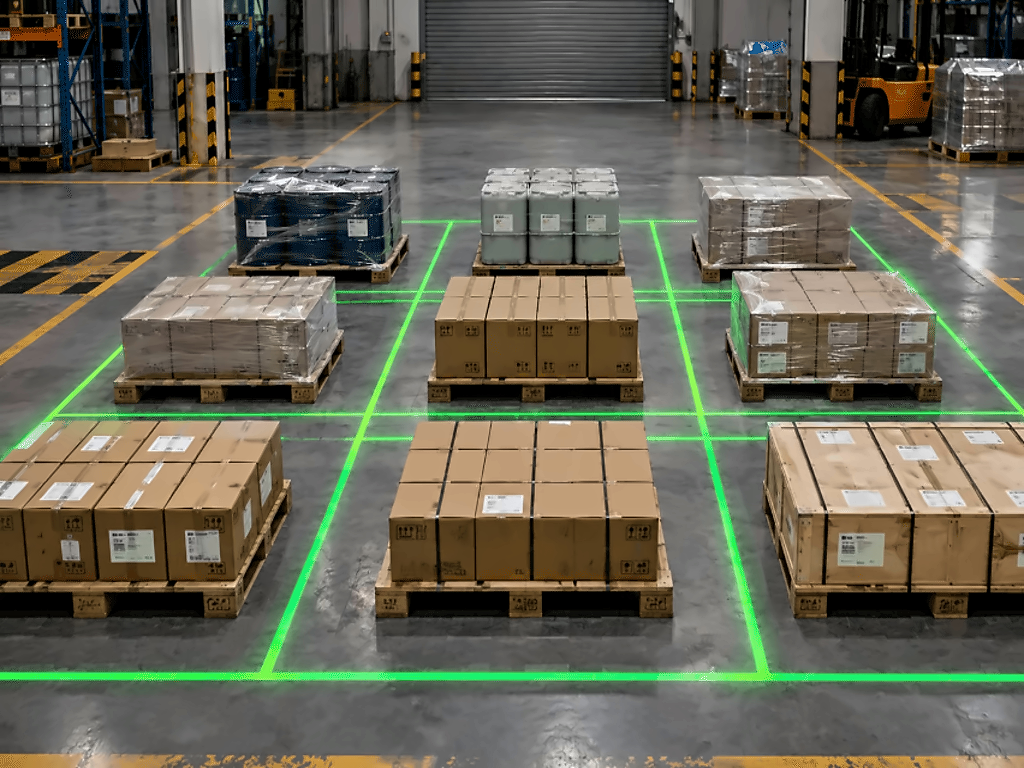
The third reference image shows a Green laser line projector grid around pallet positions. It is visually clear because the lines correspond to storage bays and the surrounding route. That kind of layout can help teams see an out-of-position pallet quickly. It should not become decorative geometry. Every line consumes attention, so the grid should include only the boundaries that matter during handling.
Line continuity should be reviewed during the busiest part of a shift. Forklifts, wrapped pallets and open doors can interrupt the beam or the viewer's sightline even when the floor is clear during setup. Walking the route from a driver's eye position helps reveal those breaks. It also shows whether a shorter segment or another mounting point would communicate the boundary more reliably.
Elevated work introduces a more serious use. A projected exclusion box can help show where people should not stand, yet it must follow the work permit and change when the lifting area changes. A Green laser line projector cannot verify that the zone is empty, and it cannot replace a spotter or physical access control. It is a visual layer within a larger procedure.
Noparde can narrow the product choice after the customer maps the route, records the longest useful segment and identifies safe mounting positions. The 70-metre request is a starting condition, not a finished specification. A successful warehouse layout usually comes from several concrete measurements and a restrained number of lines, each placed where someone has to make a real movement decision.