
 +86 18126095160
 bella@noparde.com



2026-08-15 517
Choosing the correct wattage for a gobo projector depends on four main factors: ambient light, projection distance, image size, and whether the projector will be used indoors or outdoors. A 35W or 50W gobo projector is often suitable for small indoor spaces, while 100W and 200W models are better for longer distances, larger graphics, brighter environments, and outdoor installations.
This guide explains how to choose the wattage for a gobo projector and helps you match the projector’s power to your application.
|
Projector wattage |
Recommended environment |
Typical distance |
Best applications |
|
35W |
Dark indoor spaces |
1–5 m |
Small logos, displays, private events |
|
50W |
Indoor spaces with low to moderate light |
2–8 m |
Shops, restaurants, exhibitions |
|
100W |
Bright interiors or controlled outdoor areas |
5–15 m |
Large stores, event venues, building entrances |
|
200W |
Outdoor or high-ambient-light environments |
10–30 m or more |
Building façades, public events, large advertising displays |
These distances are general guidelines. Actual performance depends on the projector’s optical system, lens, LED efficiency, gobo design, mounting angle, and surrounding light.
A gobo projector uses a light source and lens system to project a logo, pattern, message, or decorative image onto a surface. Wattage indicates the electrical power used by the light source, but it is not the only measure of projection brightness.
In general, a higher-wattage projector can produce a brighter image and support a longer projection distance or larger pattern. However, wattage should be considered together with:
For example, a well-designed 50W LED gobo projector may outperform a lower-efficiency projector with a similar rated wattage. When comparing products, ask for real projection photographs, recommended distances, and brightness data instead of relying on wattage alone.
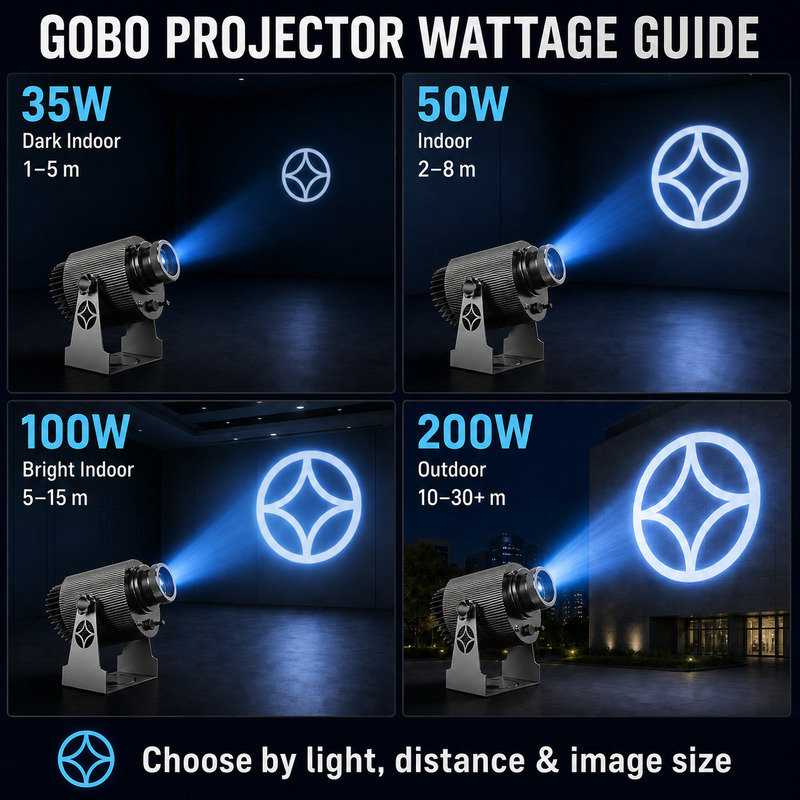
Ambient light is usually the most important factor when selecting a gobo projector.
In a dark room, nightclub, theater, or dimly lit restaurant, a 35W projector may provide a clear and attractive image. Because there is little competing light, the projected design can remain visible without extremely high output.
A 35W model is a practical choice when:
Retail stores, hotels, trade shows, wedding venues, and reception areas usually contain ceiling lights or display lighting. A 50W gobo projector is often a better starting point in these conditions.
A 50W unit can offer a stronger image without the size, heat, or cost of a more powerful model. It is commonly used for logos on floors, walls, storefront displays, and event backdrops.
For shopping centers, exhibition halls, large entrances, and covered outdoor spaces, consider a 100W projector. It provides more brightness to compete with nearby lighting and can support a larger projected image.
Direct spotlights aimed at the projection surface can still wash out the image. If possible, reposition or dim those lights even when using a high-powered projector.
Outdoor projection typically requires at least 100W, while a 200W gobo projector is more appropriate for long distances, large façades, and areas with significant ambient light.
Gobo projections are most effective outdoors after sunset. Even a powerful projector may not create a high-contrast image in direct sunlight. For daytime use, consult the manufacturer and arrange an on-site test before purchasing.
Light spreads and loses intensity as the distance between the projector and surface increases. As a result, longer projection distances generally require higher wattage.
For short distances of approximately one to five meters, a 35W projector can be sufficient in a dark or controlled indoor environment. At two to eight meters, a 50W model is often suitable for standard indoor commercial applications.
If the installation distance is between five and fifteen meters, a 100W projector provides more flexibility. For distances above ten or fifteen meters, especially outdoors, a 200W model is usually the safer choice.
These ranges may overlap because distance is only one variable. A small logo projected from ten meters may require less brightness than a very large image projected from the same position.
A larger projection spreads the available light over a wider area, reducing brightness per square meter. Therefore, the same projector will produce a brighter small logo and a dimmer large logo.
If you want to increase the pattern size, you can:
The first two options increase image size but may reduce perceived brightness. Upgrading from 50W to 100W or from 100W to 200W can help maintain visibility.
Ask the supplier for a lens chart showing image diameter at different distances. This is more useful than choosing wattage without knowing the final projection size.
Choose 35W for small indoor installations where lighting is controlled. Typical uses include cafés, home parties, intimate weddings, gallery displays, and decorative wall projections.
It is compact and economical, but it may not be bright enough for long distances or heavily lit retail spaces.
A 50W projector is a versatile option for indoor branding. It works well in restaurants, hotel lobbies, retail stores, exhibition booths, and event venues.
For many buyers asking how to choose wattage for a gobo projector, 50W offers a useful balance of brightness, size, and cost when the distance and image dimensions are moderate.
Choose 100W when the environment is brighter, the image is larger, or the installation distance is longer. It is suitable for shopping malls, large stages, corporate events, entrances, and some nighttime outdoor applications.
It also provides extra brightness when the projection surface is not ideal.
A 200W model is designed for demanding installations, including large outdoor logos, building façades, concerts, public spaces, and long-distance advertising.
Higher output may also mean greater equipment size, heat generation, energy consumption, and cost. Confirm ventilation, mounting capacity, weather resistance, and electrical requirements before installation.
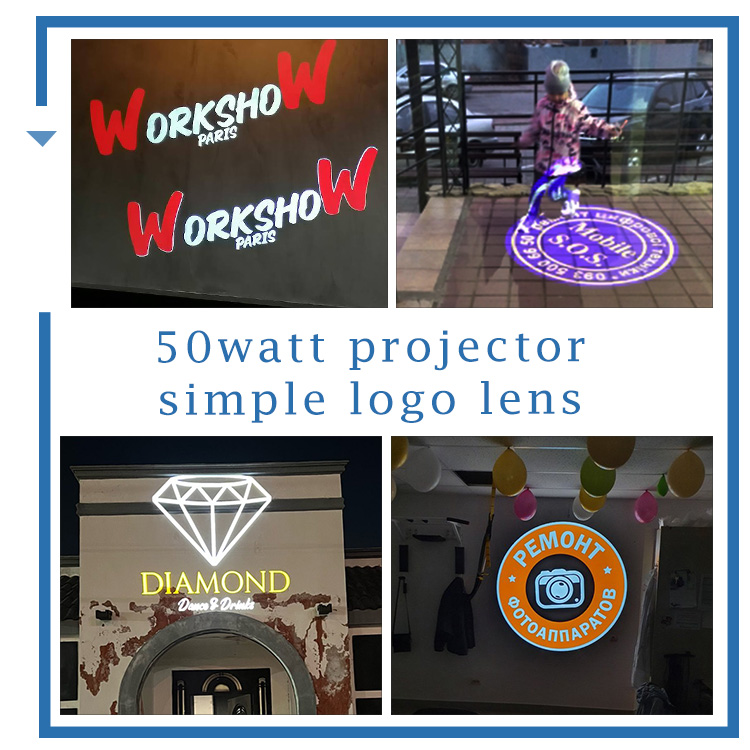
A white or light-colored matte surface produces the strongest contrast. Dark walls absorb more light, while glossy, glass, metallic, or uneven surfaces may create reflections or distortions. Increasing wattage can help, but it cannot completely correct an unsuitable surface.
The gobo design also matters. Bold logos with large, simple shapes usually remain clearer than graphics containing tiny text and fine lines. A high-quality glass gobo is often preferred for detailed, full-color artwork, while metal gobos work well for simpler single-color patterns.
If the logo contains fine details, choose the correct lens and focus system rather than relying only on additional wattage.
Outdoor installations require more than a powerful light source. Check the projector’s IP rating, operating-temperature range, cooling system, and mounting hardware.
An outdoor projector should be protected against expected rain and dust exposure. It should also be mounted securely and positioned so that water cannot enter through cables or connections. A standard indoor 200W projector should not be installed outside simply because it is bright enough.
Before ordering, provide your supplier with:
When uncertain between two models, selecting the higher wattage generally provides more brightness margin. A dim projection is difficult to improve after installation, whereas excess brightness may sometimes be managed through positioning or dimming controls.
No. Higher wattage can improve brightness, but the correct projector also depends on its optical efficiency, lens, distance, image size, and environment. An oversized model may add unnecessary cost and power consumption.
A 50W gobo projector is usually enough for short- to medium-distance indoor logo projection under low or moderate ambient light. Bright rooms, large images, and outdoor locations may require 100W or 200W.
For nighttime outdoor projection, 100W may work at moderate distances in controlled conditions. Choose 200W for larger images, longer distances, or stronger surrounding light. Outdoor visibility should always be verified with the supplier.
Indoor daytime projection may work if sunlight is controlled. Outdoor projection in direct daylight is difficult because sunlight overwhelms the projected image. Wattage alone cannot guarantee a visible daytime result.
To choose the right wattage for a gobo projector, begin with ambient light, then evaluate projection distance and image size. Use 35W for small, dark indoor spaces; 50W for general indoor branding; 100W for brighter venues, larger graphics, and moderate outdoor use; and 200W for long-distance or large-scale outdoor projection.
For the most reliable result, test the projector under real installation conditions or give the supplier complete project details. The best gobo projector is not simply the model with the highest wattage—it is the one whose brightness, lens, protection level, and projection range match your location.