
 +86 18126095160
 bella@noparde.com



2026-09-09 2,145
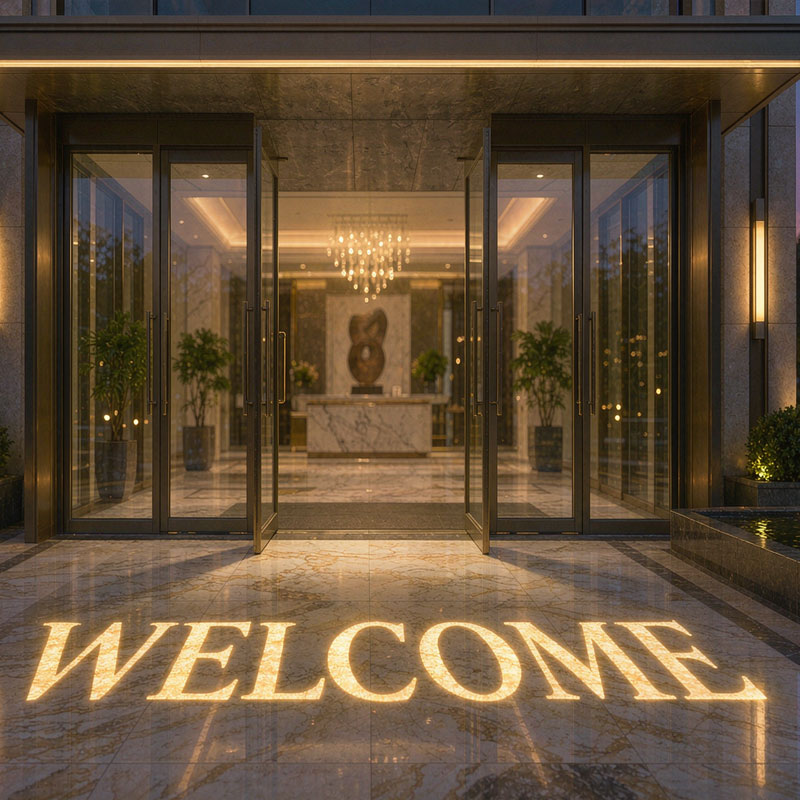
Hotel business lives and dies by first impressions, and lighting is the cheapest architecture a property can buy. A gobo projector for hotel applications does something a printed backdrop or a static sign cannot: it turns the entrance into an experience that pulls people in. A warm monogram behind the reception desk, a soft seasonal pattern across the lobby floor, or the property name glowing on the building facade — each one makes a passerby slow down and a guest feel they have arrived somewhere worth remembering. For owners and operators the goal is concrete: a hotel lobby projector that creates a welcoming, photogenic atmosphere, and exterior logo projection for hotels that works as living brand advertising after dark — together they lift footfall, dwell time and word-of-mouth. The question is rarely whether to add projection, but which unit survives long runtimes, dimmed evening scenes, guests above the installation, and weather on the exterior side. This guide breaks the decision into three parts — why gobo projection drives hotel business, which parameters matter on a spec sheet, and how to match wattage to a lobby height or facade distance — using two representative case projects.
A hotel lobby projector earns its place by doing two business jobs better than static media — and both translate directly into more guests and higher spend. First, warm atmosphere that draws people in: a soft botanical or water-ripple pattern, or a gentle brand monogram, sets a welcoming evening mood that guests visibly relax into. Because the pattern is a glass gobo you can swap in minutes, the lobby can shift from a quiet weekday calm to a festive weekend glow or a wedding backdrop without repainting or scaffolding — and guests photograph it, which puts your property in their social feeds for free. Second, exterior brand advertising that sells the visit: on the outside, building facade projection turns the hotel name and mark into glowing, moving signage that catches the eye of every passerby on the street or promenade. Unlike a lit signbox, it does not alter the building envelope, and it keeps working as 24/7 brand advertising that invites people to step inside the lobby, the bar or the restaurant — the cheapest customer-acquisition channel most hotels overlook.
The economics reinforce the business case. A unit that will project on the wall for 10–12 hours a day draws a modest LED load, is serviced by swapping a slide the size of a cookie, and can be redeployed to another wall when the lobby is renovated. Compared with fabricated signage or printed decor, projection keeps the ambiance fresh and the brand visible at a fraction of the cost — which is exactly why it pays back in added footfall rather than sitting as a fixed capital line.
Spec sheets for gobo lighting for lobbies and exteriors are not created equal. The right choice is what keeps the lobby warm and the facade legible night after night — and these are the parameters that separate a durable, guest-pleasing installation from a refund request.
Lobbies are rarely dark. Reception desks run 200–300 lux at the counter, and floor zones often sit at 100–150 lux. A 35 W unit (roughly 2,000 lm) will project on the wall convincingly only in dim corners; a 55 W unit (~3,300 lm) holds contrast across most evening scenes and gives that warm, inviting lobby glow; the 100 W class (~6,000 lm) is what a sun-lit atrium or a night-time facade typically needs. Match lumens to the measured ambient light at the receiving surface, not to the marketing claim.
Every gobo optic has a working range — Noparde's indoor tier covers 2–8 m at 35–55 W and 2–12 m at 100 W, while the outdoor IP65 tier reaches 5–40 m at 200 W. Beyond the range, focus softens and the image dims. Image diameter scales roughly with throw: confirm the supplier's projected-size table so the monogram fills the feature wall instead of floating as a small coin on it.
Fine logotypes and serif wordmarks demand a high-resolution optical train and a precision glass gobo. Stamped metal gobos suit silhouettes only; full-color photographic patterns require dichroic glass. Ask for a projected sample of your own artwork at the working distance before committing.
Interior units live in conditioned air and are forgiving. Anything that will project on the wall of a building exterior needs at minimum IP65 (dust-tight, water-jet resistant), an aluminum housing that sheds heat, and a Cree-class LED source rated for tens of thousands of hours. High-power facade units such as Noparde's 500 W outdoor building projector pair a 30 kg aluminum body with AC110–240V wide-voltage drivers precisely because enclosure temperature, not LED rating, is what usually kills outdoor installs.
A fan that is inaudible in a warehouse is unacceptable under a lobby vault at midnight. Insist on measured dB(A) at 1 m for interior units, and budget the true wattage into the property's lighting load.
|
Space |
Typical throw |
Recommended class |
Key requirement |
|
Reception feature wall / corridor |
2–8 m |
35–55 W indoor |
Whisper-quiet, warm dimmer scenes |
|
Full-height lobby wall, mezzanine |
3–12 m |
100 W indoor |
Lumen headroom for 200+ lux zones |
|
Entrance canopy / driveway |
2–15 m |
100 W IP65 |
Weather sealing, angle bracket |
|
Mid-rise facade, courtyard |
5–40 m |
200 W IP65 |
High contrast vs. street light |
|
High-rise facade / landmark |
2–80 m |
500 W outdoor building projector |
Cree LED, 30 kg alloy housing, waterproof variant |
The logic is simple: buy lumens for the ambient light, throw for the mounting geometry, and ingress protection for the weather — in that order of non-negotiability.
When The Hallmarq Grand, a 280-room downtown property, repositioned its lobby bar to draw more evening guests, the design team wanted a warm, memorable welcome — but the heritage-listed marble wall ruled out fabricated signage entirely. The solution was a pair of 55 W indoor gobo projectors, mounted on the mezzanine rail roughly 6 m from the wall, each fitted with a two-color glass gobo of the crest and a soft botanical pattern that runs through dinner service. Because the fixtures project on the wall from within guest view, silence was a hard requirement; the units run effectively inaudible at guest distance, and their 2–8 m working range matched the throw almost exactly, keeping the image sharp and the mood warm. The result was a lobby people chose to sit in: bar covers rose as guests lingered past their first drink, and the crest wall became the property's most-shared backdrop on social media — free, repeatable advertising. Operations now swaps the gobo for holiday and wedding-venue artwork, a few hundred dollars a year, turning the same wall into a rotating reason for guests to come back.
Hotel Aurora Riverside, a 21-story beachfront property, wanted its name to pull evening strollers off the promenade and into the lobby lounge — but its glass curtain-wall facade forbids sign penetration. The marketing answer was building facade projection: two 200 W IP65 units on the podium roof, throwing the glowing wordmark 30 m up onto the stone-clad north face as live brand advertising after dark. The result was measurable: passersby who had walked past the unlit tower now stopped, photographed the name, and walked in — front-desk staff reported a clear rise in walk-in guests to the lobby bar on projection nights. The exterior specification differed from any lobby job in four ways. Brightness: the facade competes with street lighting and river reflections, so 200 W was the entry point, not the ceiling. Water ingress: IP65 housings, sealed glands, and marine-grade anchors for coastal air. Thermal load: ten hours nightly in 30 °C ambient demanded aluminum heat-sinking and a 10 cm rear clearance, written into the mount detail. Projection angle: the throw stays within 25° of perpendicular to avoid keystoned letters, and the wordmark was proofed against photographs of the actual stone texture — which caught a legibility problem with thin letter strokes before manufacturing. For higher towers in the group's pipeline, the same team now specifies Noparde's 500 W outdoor building projector, whose 2–80 m range and 30 kg alloy body exist for landmark-scale names.
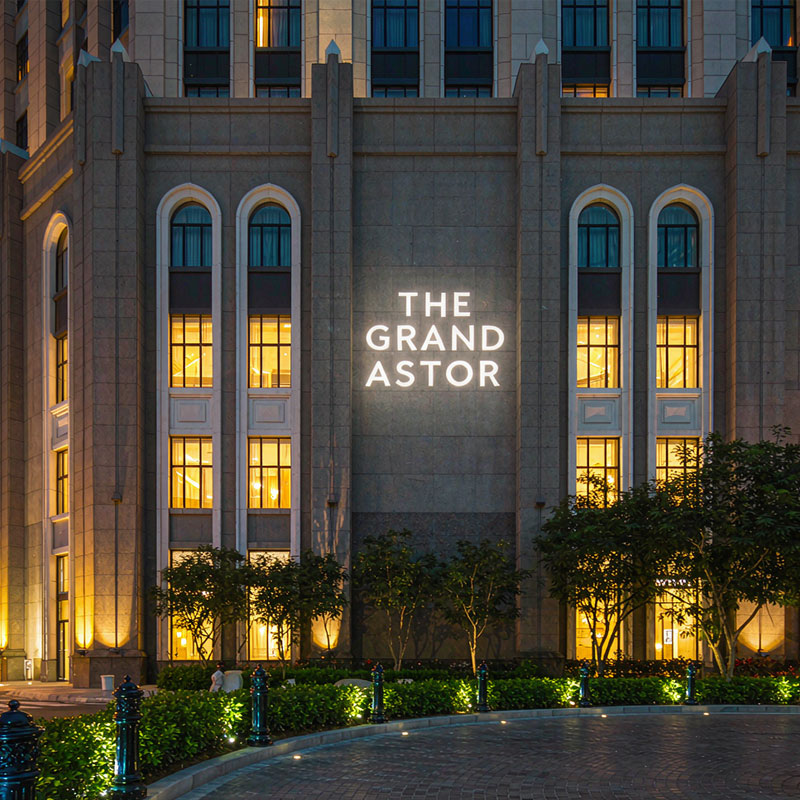
So, which gobo projector for hotel spaces wins the most business? For a warm, welcoming lobby within 8 m, a 55 W indoor unit is the balanced answer — it delivers the glow that makes guests linger and share. Tall atria and bright zones justify the 100 W class; entrance canopies move to 100 W IP65. And a property name that must climb a facade and pull strangers off the street starts at 200 W IP65, with the 500 W outdoor building projector reserved for high-rise and landmark advertising. A lobby that feels like a destination and a facade that advertises you all night long are the two cheapest ways to fill more rooms, bars and restaurants — so specify the wattage for the job, prove your own artwork on the real wall, and let the light bring the guests in. To review the full lineup and request a projected proof of your own logo, visit the Noparde logo projectors page.