
 +86 18126095160
 bella@noparde.com



2026-09-03 1,449
When a warehouse has a 10-meter clear ceiling, managers often ask a simple question with a surprisingly technical answer: how many watts does a floor safety projector actually need? The short version is that most dedicated forklift safety warning lights are built for short throws and will not reach the floor from that height. At 10 m you typically need a 100 W unit at minimum and a 200 W unit for a bright, high-traffic facility. This article explains the physics, shows Noparde's real wattage ladder, and walks through a distribution-center case where the right power choice cut near-misses sharply.
Light spreads as it travels. A projector placed 10 m above the floor sends its beam across a long path, so the same lumens land on a much larger, dimmer area than at 3 m. Two factors decide whether a warning mark stays readable:
The rule of thumb: add roughly 60–80% more output for every extra 5 m of height, and then add margin for ambient light. That is why a unit perfect for a 3 m retail entry fails badly in a 10 m rack aisle.
Based on Noparde's real product lineup, here is how the common powers compare for a 10 m ceiling pointing down to the floor:
|
Model line |
Power |
Rated throw |
Fits 10 m ceiling? |
|
Floor Sign Projector |
55 W (Cree LED) |
2–7 m |
No — max 7 m |
|
GOBO-P50 |
50 W |
2–8 m |
No — max 8 m |
|
GOBO-P100 Pro |
100 W |
2–15 m |
Yes — marginal in bright light |
|
GOBO-P200 Max (IP65) |
200 W |
5–40 m |
Yes — recommended for 10 m |
Typical ground illumination at a 10 m throw tells the same story: a 55 W floor sign lands around 8–12 lux (fine only in dim spaces), a 100 W unit about 20–25 lux (visible in moderate warehouse light), and a 200 W unit about 45–60 lux (clear against 150–250 lux ambient). Figures vary with pattern size and surface color, but the ranking is consistent.
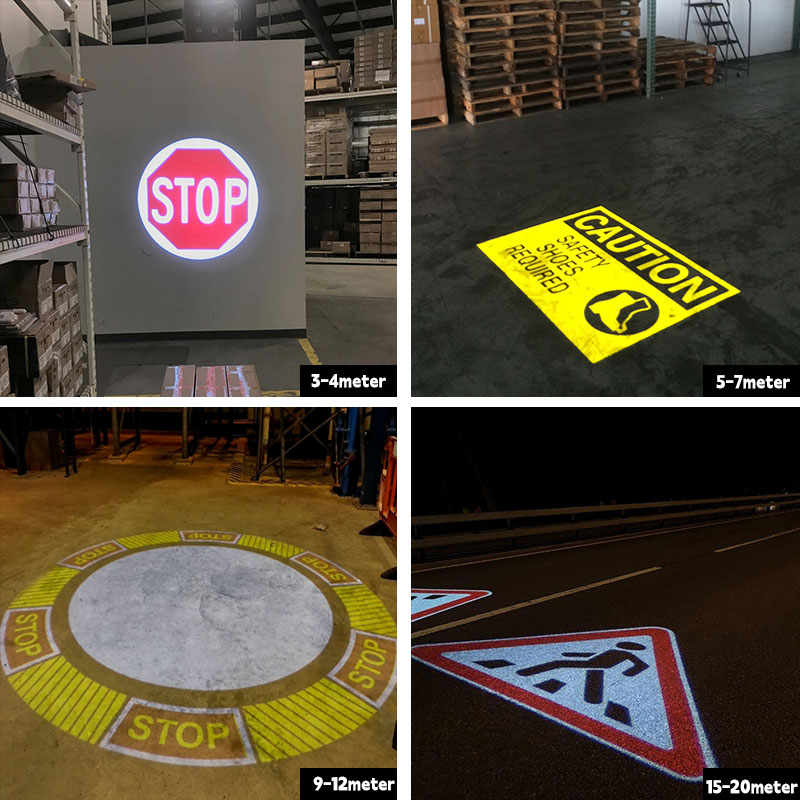
Consider a representative regional distribution center we will call Meridian DC: a 12,000 m² facility with a 10 m clear ceiling, high-bay LED lighting near 180 lux at floor, 34 forklifts in daily operation, and mixed pedestrian and vehicle traffic around dock doors and picking intersections. The site had recorded repeated near-misses where walkers stepped into aisle crossings without seeing an approaching truck.
The safety team first tested a 55 W floor forklift safety warning lights unit, the same model used in retail entries. From 10 m it never reached the floor — the beam faded out near 6 m. They then trialed a 100 W unit projecting a red "CAUTION — FORKLIFT" arrow at each main intersection. It was readable but washed out during peak daytime operations.
The final specification used 200 W IP65 safety projectors on a rotatable mount, projecting static STOP and directional warnings plus a blue "approach" spot ahead of each truck path. Installers set a 10 cm rear clearance for cooling and aimed units perpendicular to the floor to keep marks sharp.
|
Metric |
Before (55–100 W trial) |
After (200 W IP65) |
|
Floor warning visibility at 10 m |
Poor / faded |
Clear in full operation |
|
Near-misses per month |
14 |
3 |
|
Reportable pedestrian incidents |
2 / year |
0 |
|
Operator slowdown at crossings |
Inconsistent |
Consistent |
The 200 W choice mattered because it gave margin: even when dock doors opened to daylight or housekeeping raised ambient levels, the warning held. Throughput stayed flat, and the EHS lead later cited the projection layer as a low-cost addition to the existing traffic plan. One detail worth noting — during the 100 W trial, the warning looked strong at 7 a.m. but faded by 10 a.m. as skylights and open bays lifted floor light past 200 lux. That single observation is why the team stopped treating wattage as a rough guess and started matching it to measured lux.
The 55 W floor sign never projected past 6–7 m, leaving a dark gap between the unit and the floor — useless for a 10 m ceiling. The 100 W unit closed that gap but split its output across a larger ground area, so per-square-meter brightness dropped below the 150 lux background during busy hours. Only the 200 W class delivered the contrast needed for a pedestrian to notice the mark in under two seconds, the threshold EHS uses for a usable warning.
Match power to three inputs, in this order:
For most 10 m warehouses, 200 W IP65 forklift safety warning lights are the safe default; 100 W is acceptable only in dimmer, low-traffic zones.
EHS and procurement teams repeat a few predictable errors when specifying safety projectors:
A 15-minute lux measurement at the actual mounting point removes most of this guesswork and prevents the expensive second purchase.

How many lumens do I need at a 10 m ceiling? Roughly 6,000 lm for a 100 W class and 12,000 lm for a 200 W class. The exact floor lux also depends on pattern size and ambient light, so measure on site.
Can a 55 W floor safety projector work at 10 m? No. Noparde rates it for 2–7 m. From a 10 m ceiling the beam fades before reaching the floor; you need 100 W minimum.
Is higher wattage harder to maintain? Not meaningfully. IP65 housings are sealed against dust and water jets, and LED gobo sources run tens of thousands of hours. Plan a quarterly lens wipe and an annual check of the mounting bracket.
What is the maximum safe installation height? A 200 W unit is rated to 40 m, so 10 m is well within range. Keep a 10 cm rear clearance for cooling and aim perpendicular to avoid distorted marks.
Can I mix wattages across one facility? Yes, and it is often the efficient choice. Use 200 W at bright, high-traffic crossings and 100 W in dim storage zones. A lux map of the building shows exactly where each tier belongs, so you avoid over-specifying quiet areas.
For a 10-meter warehouse ceiling, specify safety projectors at 200 W (IP65) for reliable, all-day forklift safety warning lights, and reserve 100 W for dimmer zones. Power is not a marketing number — it is what keeps the warning visible when the floor is busy. Explore Noparde's SafetyCast virtual sign logo projector for warehouse and forklift safety projection, or send your ceiling height and floor lux for a tailored recommendation.